Certificate type
Battery Storage (EESS) Commissioning Certificate software
BS 7671:2018+A4:2026 Chapter 57 · PAS 63100:2024 (domestic) · IET Code of Practice for Electrical Energy Storage Systems, 3rd edition · BS EN IEC 62485 series
The Battery/EESS Commissioning Certificate records the installation of a battery energy storage system, whether standalone or paired with solar PV. Domestic installations are assessed against PAS 63100, the dedicated domestic battery-storage fire-safety standard; commercial and industrial installations follow a fire risk assessment referencing the IET Code of Practice for Electrical Energy Storage Systems and BS EN IEC 62485. CertSync structures the certificate around whichever route applies.
What is a battery storage (EESS) commissioning certificate?
A Battery/EESS Commissioning Certificate records the installation of a battery energy storage system and confirms the fire-safety and electrical checks appropriate to its scale — PAS 63100 for a domestic dwelling, or a fire risk assessment referencing the IET Code of Practice for EESS for commercial and industrial installations.
Key features
- Sector-aware fire-safety section — the full PAS 63100 domestic siting checklist covering every prohibited location, or a commercial/industrial fire-risk-assessment reference
- Battery chemistry and usable capacity (kWh) recording
- Charge, boost and float voltages, plus the DC wiring and earthing arrangement of the battery installation
- Fire detection near the battery, and any backup (island) capability recorded against the connection route
- Records the paired Solar PV certificate number for a combined generation-plus-storage job, and client details can carry across between certificates
- Arc flash risk assessment record — reference, assessed incident energy, and confirmation the battery location was selected on that basis
How is the certificate printed, sent and checked?
- The sign-off and declaration sit on page 1, with the detailed records after them.
- Every option on the form is printed, with your answer ticked, so the reader sees what was chosen and what was not.
- The footer reads "Prepared using CertSync", and the certificate states that the contractor named on it is responsible for its contents.
- Print a QR sticker for the installation. Scanning it opens a public verification page that asks for the property postcode and keeps the customer’s personal details hidden.
- Email the signed PDF to your customer from the app. Sending needs a connection.
The issued certificate
See a real battery storage (EESS) commissioning certificate
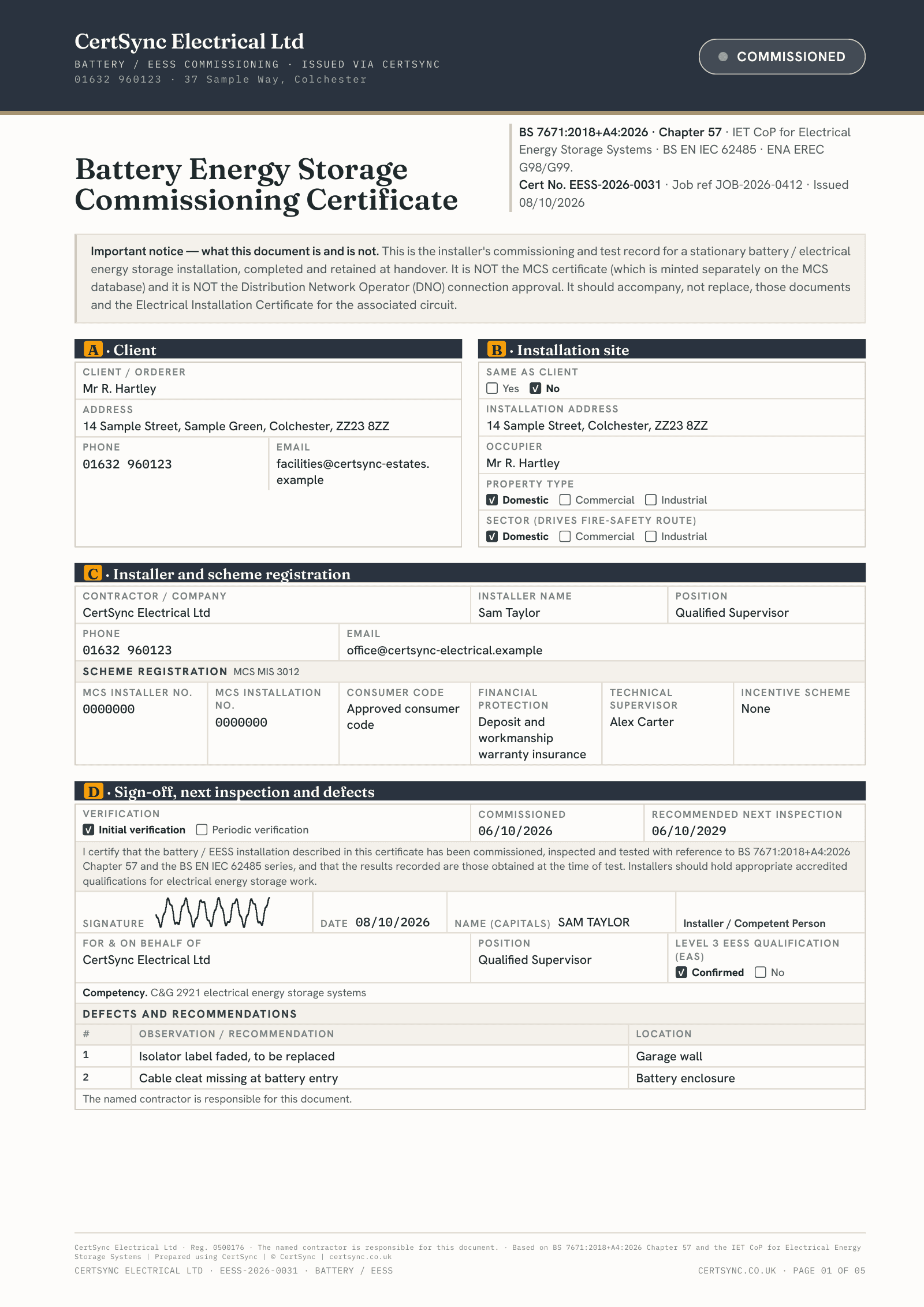
What this certificate includes
- You choose the sector, domestic, commercial or industrial, and it decides the fire-safety section: a dwelling follows PAS 63100, commercial and industrial premises follow the fire risk assessment route under BS 7671 Chapter 57. The certificate cannot be issued until a sector is chosen.
- On a dwelling, the installer confirms the battery is not sited in a PAS 63100 prohibited location, with itemised answers for sleeping rooms, cellars or basements without external access, outdoor clearances, stored flammable materials and the escape route. An itemised answer that contradicts the overall confirmation stops the certificate being issued.
- On commercial and industrial premises, the installer must confirm the premises fire risk assessment was considered in choosing the battery location, and can record its reference and date, a siting rationale, fire detection, ventilation, and segregation from escape routes and combustibles.
- A domestic certificate carries a PAS 63100 statement of conformity, with an answer for each subject it covers. Declaring full conformity while any answer is non-conformant blocks issue, and so does declaring conformity with exceptions without listing them.
- The battery system section records the chemistry, make, model and serial number, nominal and usable capacity, nominal DC voltage, maximum charge and discharge power, the battery management system and its firmware version, the number of modules and enclosures, and the MCS MIS 3012 integration class.
- The inverter section records the make, model and serial number, the rated AC output, any export limit, the DNO and the ENA connection route. A G98 route prints the factory-fixed settings note and the DNO notification details; a G99 route prints the DNO protection settings schedule and the values programmed into the inverter.
- The number of phases must be recorded whenever a G98 or G99 route is chosen. On a G98 route, a capacity above the G98 limit for that phase arrangement is flagged before you issue, and a battery recorded as providing an island or backup supply blocks issue.
- The test results cover DC insulation resistance positive and negative to earth with the test voltage, AC insulation resistance, polarity, loop impedance and fault current in charging mode and, where there is a backup supply, in island mode with its own earthing arrangement, plus the RCD test and the test instrument with its calibration date.
- A DC insulation reading below the minimum for the circuit, judged on its nominal DC voltage and whether it is SELV or PELV and never on the test voltage, an AC reading below the minimum, unconfirmed polarity, a failed loss-of-mains test or a failed charge and discharge test is flagged before you issue.
- Boost and float voltages, charge rate, low-voltage shutdown and boost time are recorded as configured. The certificate states that these are not compared against the manufacturer’s datasheet, so they are verified directly against it.
- Ventilation, the DC isolator rating and location, AC isolation and the emergency shutdown procedure are recorded, with the battery-presence notices at the origin, the metering position and the consumer unit. A required notice recorded as missing blocks issue.
- An arc flash assessment can be recorded with its reference, the assessed incident energy and its unit. On a dwelling, a figure in cal/cm² above the PAS 63100 limit blocks issue; a figure in any other unit is flagged for checking rather than converted.
- The certificate covers installer-completed commissioning up to industrial-premises scale. A recorded capacity or discharge power at grid or utility scale raises a warning that the system is outside its scope.
- A DC- or AC-coupled battery can name the Solar PV certificate it is paired with, and the associated EIC by number and date. Page 1 explains that this record accompanies the EIC, the MCS certificate and the DNO connection approval, and replaces none of them.
Domestic, commercial and industrial use
Domestic use
Domestic battery storage is assessed against PAS 63100, the dedicated domestic fire-safety standard for battery energy storage systems. CertSync structures the domestic certificate around the PAS 63100 siting and fire-safety checklist alongside the electrical test results. Dwellings over 200m² sit outside the specification’s stated scope; the same fire-safety principles can still be applied, with a fire safety expert consulted.
Commercial use
Commercial battery installations — including multi-occupancy buildings — are outside PAS 63100's domestic-only scope. BS 7671 Chapter 57 requires a fire risk assessment for non-domestic battery installs, and the IET Code of Practice for EESS, 3rd edition, provides the fire-safety and siting guidance CertSync's commercial certificate references.
Industrial use
Industrial battery storage follows the same commercial-route fire risk assessment plus the IET CoP for EESS. BS EN IEC 62485 (the stationary-battery safety standard, with a lithium-specific part) provides the scale-agnostic safety basis for the electrical checks. Grid-scale or utility battery storage sits outside the scope of this certificate — that scale falls under a different commissioning regime entirely, and CertSync warns when a recorded system is above 1,000 kW or 1,000 kWh.
Frequently asked questions
- Does my battery storage certificate cover a domestic garage installation?
- Yes — PAS 63100 is the domestic battery-storage fire-safety standard and covers installations within a private home, including a garage-mounted battery. CertSync's domestic certificate is structured around the PAS 63100 checklist. Dwellings over 200m² sit outside the specification’s stated scope, but it is still a dwelling — the same fire-safety principles can be applied, with a fire safety expert consulted, rather than switching to the non-domestic route.
- What is the difference between PAS 63100 and the IET EESS Code of Practice?
- PAS 63100 is scoped to dwellings and does not cover commercial or industrial premises. For those, BS 7671 Chapter 57 requires the battery's location and fire protection to be selected taking the premises fire risk assessment into account, and the IET Code of Practice for Electrical Energy Storage Systems, 3rd edition, provides the supporting fire-safety and siting guidance.
- Do I need a fire risk assessment for a commercial battery installation?
- Yes. BS 7671 Chapter 57 requires a fire risk assessment for non-domestic battery installations. CertSync's commercial/industrial certificate route records the assessment’s reference and date, and requires confirmation that it was considered in siting the battery, alongside the electrical commissioning results.
- Can I certify a combined solar PV and battery storage installation on CertSync?
- Yes. CertSync supports both a Solar PV Commissioning Certificate and a Battery/EESS Commissioning Certificate. The battery certificate records the paired Solar PV certificate number, and client details can carry across between certificates.
- Does CertSync cover grid-scale battery storage?
- No. This certificate is scoped to installer-completed domestic, commercial and industrial battery installations. Grid-scale or utility-scale battery storage sits under a different commissioning regime and is out of scope. CertSync warns, but does not block, when a recorded system is above 1,000 kW or 1,000 kWh.
- What battery chemistries does the certificate support?
- Choose lithium-ion, lithium iron phosphate, lead-acid, nickel-cadmium or nickel-metal-hydride, or record another chemistry under Other. The certificate also records usable capacity and the charge, boost and float voltage settings.
Related certificates and guides
Get started with CertSync
Start free — first month on us. All 13 certificate types, one subscription.
First month free, card required, then From £15/month. No fixed-term contract. Cancel any time.