Certificate type
Electric Vehicle Charge Point (EVCP) certificate software
IET Code of Practice for Electric Vehicle Charging Equipment Installation, 5th edition · SI 2021/1467 (Electric Vehicles (Smart Charge Points) Regulations 2021)
The EVCP certificate records the installation of an electric vehicle charging point and confirms that the work has been carried out to the requirements of the IET Code of Practice for Electric Vehicle Charging Equipment Installation, 5th edition. EV charger installation involves specific technical considerations not covered in an EIC alone — particularly around earthing arrangements, load management and regulatory notification. CertSync covers these in a structured wizard built for installers who work in this discipline.
What is an EV charge point certificate?
An Electric Vehicle Charge Point (EVCP) certificate records the installation of an EV charging point and confirms it was carried out to the IET Code of Practice for Electric Vehicle Charging Equipment Installation, 5th edition. It captures the EV-specific elements an EIC alone does not — the earthing arrangement assessment, load management and any DNO notification.
Key features
- PME earthing assessment section — structured assessment for TN-C-S supplies per IET Code of Practice guidance
- DNO connection route — connect-and-notify or apply first for a load-only charger, and G98, G99 or G100 where the vehicle can export (V2G)
- Load management details — records load management provisions where applicable
- Charge point technical details — manufacturer, model, rated power, connector type, IP rating
- SI 2021/1467 — for a smart charge point in scope, records whether the manufacturer’s statement of compliance with the Electric Vehicles (Smart Charge Points) Regulations 2021 was supplied
- Digital signature and PDF — signed, locked certificate ready to hand to the client or building owner
How is the certificate printed, sent and checked?
- The sign-off and declaration sit on page 1, with the detailed records after them.
- Every option on the form is printed, with your answer ticked, so the reader sees what was chosen and what was not.
- The footer reads "Prepared using CertSync", and the certificate states that the contractor named on it is responsible for its contents.
- Print a QR sticker for the installation. Scanning it opens a public verification page that asks for the property postcode and keeps the customer’s personal details hidden.
- Email the signed PDF to your customer from the app. Sending needs a connection.
The issued certificate
See a real EV charge point certificate
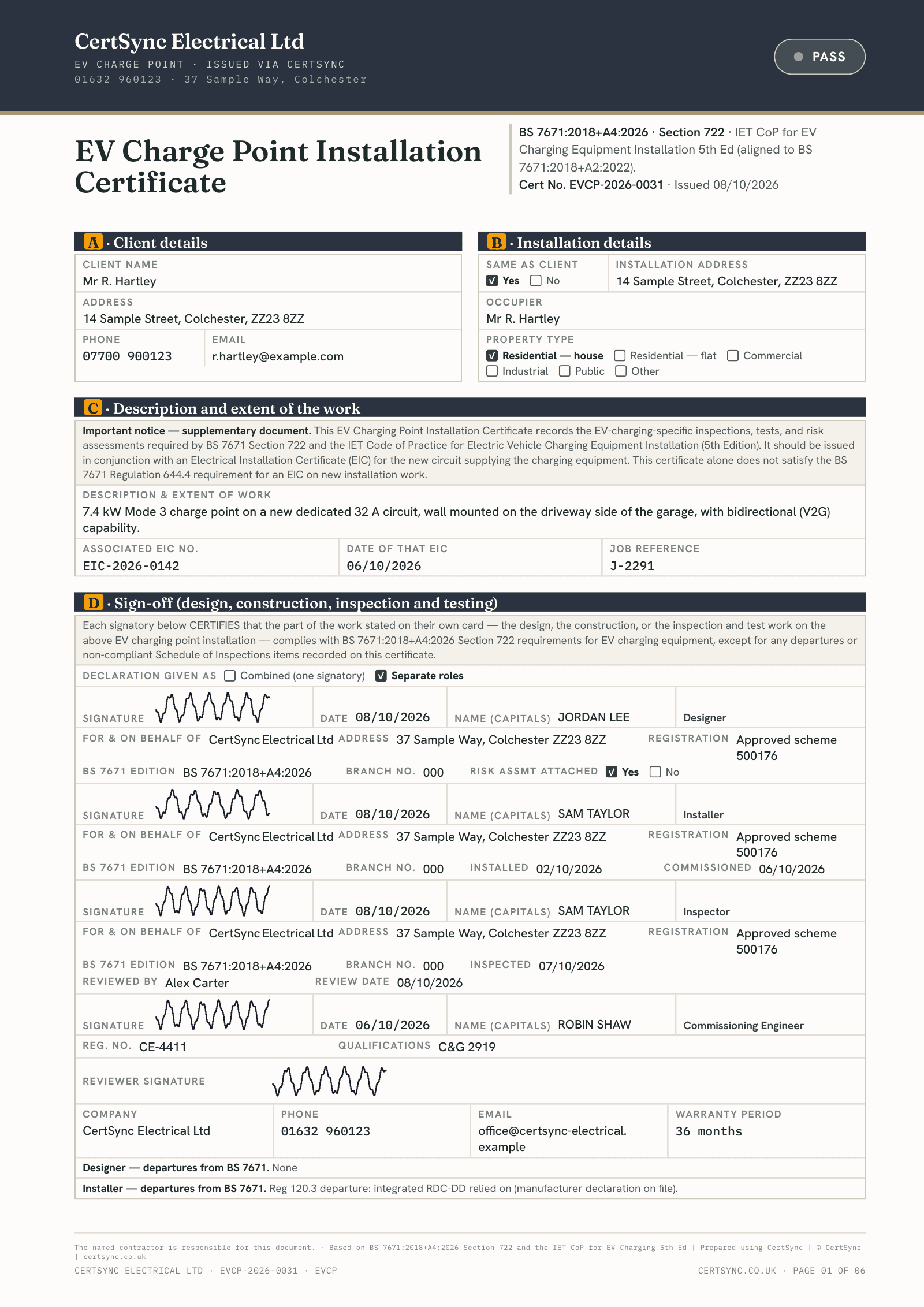
What this certificate includes
- Page 1 states that this is a supplementary document, to be issued with an Electrical Installation Certificate for the new circuit feeding the charger, and records the associated EIC number and date.
- The charge point section records the make, model and serial number, maximum and configured output, charging mode, socket or tethered, the connectors fitted and their standard, the EV marking, the mounting height and the installed IP rating.
- One certificate covers one charge point on one final circuit, and recording more than one on the circuit stops it being issued. The supply phase count must also be recorded before issue.
- On a PME supply the certificate must say whether a vehicle may be charged outdoors. Where it may, it cannot be issued until a Regulation 722.411.4.1 protective measure is recorded: an earth electrode, or an open-PEN protective device with the indent it relies on.
- With an earth electrode, both the measured resistance and the maximum worked out for that site must be on the certificate, and a reading above that maximum is flagged before you issue. With an open-PEN device, a failed device test is flagged too.
- The RCD type protecting the charging circuit must be recorded, including Type A with a DC detection device, Type B or an RDC-PD. A type that gives no smooth-DC fault detection blocks issue unless the DC detection device relied on is named with its product standard.
- Once the protective device and rating are chosen, the form fills in the maximum Zs for the circuit with the earthing arrangement taken into account, so on a TT supply the RCD sets the limit. Where no limit applies it leaves the field blank rather than guessing.
- Test results cover continuity, insulation resistance live to live and live to earth with the test voltage, Zs, earth fault current, RCD operating time, polarity, a functional test and the test instrument with its calibration date. At least one insulation reading is needed before issue.
- A recorded failure is flagged before you issue: insulation below the BS 7671 Table 64 minimum, an RCD operating time outside the limit, a Zs above the recorded maximum, incorrect polarity or a failed functional test.
- Checks from an EV charge point tester (control pilot interlock, protective earth, PE error and CP error) and the isolator’s load-break and disconnect tests are recorded as pass, fail or not tested. Any recorded fail is flagged before you issue.
- The DNO route is worked out from the demand per phase and the ENA connections form criteria (cut-out rating, looped service, metered supply): connect and notify or apply first for a load-only charger, and G98, G99 or G100 for vehicle-to-grid.
- For a smart charge point within the scope of the Smart Charge Points Regulations 2021, the form asks whether the manufacturer’s statement of compliance was supplied. It is printed as the manufacturer’s statement, not as something the installer attests.
- For a public charge point, how it is protected against impact must be recorded: by position, by mechanical protection or by IK-rated equipment. An IK rating below the minimum the regulation sets is flagged before you issue.
- Sign-off is either one combined declaration or separate designer, installer and inspector declarations. Every declaration printed must be named, signed and dated before issue, and so must a separate commissioning engineer.
- Once the certificate is issued, CertSync records when its re-inspection falls due, lists it in the Renewals due panel on your dashboard and emails you 90, 30 and 7 days before that date.
Domestic, commercial and industrial use
Domestic use
Domestic EVCP installations — typically 7kW home charge points — require careful consideration of the supply earthing arrangement. Where a PME (Protective Multiple Earthing, also described as TN-C-S) earthing system is present, the IET Code of Practice sets out the assessment process that must be applied before installation proceeds. CertSync’s PME earthing assessment section applies whenever the supply is PME.
Commercial use
Commercial EVCP installations in car parks, office buildings, retail sites and fleet depots often involve multiple charge points, higher-power AC or DC charging, and load management requirements. Each certificate records one charge point and its final circuit, so issue one per charger, with the load management provisions made and the supply characteristics of the installation.
Industrial use
Industrial and fleet charging installations may involve high-power DC rapid chargers and specialist protection arrangements. CertSync supports the full range of installation types covered by the IET Code of Practice, including rapid and ultra-rapid charging equipment.
Validation as you enter results
Built-in BS 7671 validation flags out-of-range values as you enter test results, with the relevant regulation reference. It assists the competent person and does not replace professional judgement.
How to certify an EV charge point installation
Certifying an electric vehicle charge point combines the electrical certification with the EV-specific checks.
- Assess the supply and earthingA competent installer assesses the existing supply, earthing arrangement and the protective measures the charge point requires.
- Install the charge pointThe charge point and its dedicated circuit are installed to BS 7671 and the IET Code of Practice for EV charging equipment.
- Inspect and testThe installation is inspected and tested, including the EV-specific protective devices and disconnection checks.
- Record both certificatesIssue the EIC for the new circuit and the EVCP certificate for the EV-specific elements, reusing the client and site details across both.
- Hand over and retainThe signed certificates are issued to the client and retained as evidence the charge point was installed and tested correctly.
How to complete an EV charge point certificate in CertSync
The EVCP wizard records the charger, its supply and earthing, the risk assessment where PME is involved, the inspection and test results, and the notifications.
- Client DetailsEnter the client details.
- Installation AddressEnter the installation address and the Description & Extent of Work. If an EIC was issued for the new circuit, add its number and date under Associated EIC Certificate No. and Associated EIC Date.
- Charge Point DetailsRecord the charger, its Connector Configuration, Smart Features & Load Management, and the Supply & Load Factor (phases, demand before and after, and how the load is shared).
- Supply & PME ComplianceRecord the PME Protection Method where the supply is PME or combined neutral and earth. The wizard flags when a method is required.
- Risk Assessment (Form B1)Complete the PME & Location Assessment, the Simultaneous Contact and Touch Voltage risk assessments, and the Risk Assessment Conclusion.
- Circuit DetailsRecord the Means of Isolation, the DNO Connection Pathway, Vehicle-to-Grid details if relevant, and the charger circuit.
- Schedule of InspectionsWork through the inspection sections (installation, supply, protective devices, PME earthing, earthing and bonding, labelling, smart functionality and functional tests) and add Observations.
- Test ResultsEnter continuity, insulation resistance, earth fault loop and RCD results, the functional and EV-specific tests, and the Test Instrument used. The RCD operating time at the rated residual current cannot exceed 300 ms for the certificate to be issued.
- Code of Practice ChecklistComplete the Pre-Installation, Installation and Commissioning checks.
- NotificationsRecord the DNO Notification (the wizard warns when a prior application is required) and, if applicable, the OZEV grant reference.
- Declaration & SignaturesChoose the Declaration Mode, sign the declarations, add company information and the Recommended Next Inspection date.
- Photos & Supporting DocumentsAttach photos and supporting documents.
- Certificate ReviewCheck the summary and submit for review.
Do not leave the associated EIC blank when one exists. The EVCP certificate is written to travel with the EIC for the new circuit.
Frequently asked questions
- Do I need a separate EVCP certificate if I have already issued an EIC for the charger installation?
- The EIC certifies the electrical installation work to BS 7671. The EVCP certificate additionally records the EV-specific elements required by the IET Code of Practice — including the PME earthing assessment, load management provisions and DNO notification. Both documents serve different purposes and many installers issue both. In CertSync both sit against the same customer and site, and the client and site details carry across from one to the other.
- What is a PME earthing assessment and when is it needed?
- A PME assessment is required when the supply to the installation uses a Protective Multiple Earthing arrangement (commonly described as TN-C-S). The IET Code of Practice sets out the measurement and assessment process to determine whether the PME earth is suitable for the proposed charge point installation. Where it is not suitable, the Code of Practice describes alternative protective measures. CertSync’s PME section applies whenever the supply is PME.
- Are smart charge points covered?
- Yes. The Electric Vehicles (Smart Charge Points) Regulations 2021 (SI 2021/1467) apply to private smart charge points of 50 kW or less. For a charge point in that scope, the certificate records whether the manufacturer’s statement of compliance with the Regulations was supplied.
- When does the DNO need to be notified for an EV charger?
- Notification to the Distribution Network Operator may be required depending on the charge point rating, the supply arrangement and whether the connected load exceeds the relevant threshold. CertSync works out the route from the ENA connections form criteria and records the notification date and reference, so the certificate documents the decision.
- What protection does an EV charge point installation require?
- EV charging draws sustained load and introduces specific shock and DC-fault considerations, so the installation must provide appropriate RCD protection and, where required, protection against DC fault current — either built into the charge point or provided by the circuit. CertSync records the protective device and RCD type for the charge point circuit as part of the certificate.
- Can CertSync produce both the EIC and the EVCP certificate?
- Yes. CertSync supports all 13 certificate types on one subscription, so you can issue the EIC for the electrical work and the EVCP certificate for the EV-specific elements from the same account, reusing the client and site details across both documents.
- How do I complete an EV Charge Point certificate in CertSync?
- The EVCP wizard records the charger, its supply and earthing, the risk assessment where PME is involved, the inspection and test results, and the notifications. The steps are: Client Details; Installation Address; Charge Point Details; Supply & PME Compliance; Risk Assessment (Form B1); Circuit Details; Schedule of Inspections; Test Results; Code of Practice Checklist; Notifications; Declaration & Signatures; Photos & Supporting Documents; Certificate Review.
- Where do I record the EIC on an EV charge point certificate?
- Enter the EIC number and date under Associated EIC Certificate No. and Associated EIC Date on the Installation Address step. The EVCP certificate is issued alongside the EIC for the new circuit, so the two documents refer to each other.
Related certificates and guides
Get started with CertSync
Start free — first month on us. All 13 certificate types, one subscription.
First month free, card required, then From £15/month. No fixed-term contract. Cancel any time.