Certificate type
Lightning Protection Test & Inspection Report software
BS EN IEC 62305 Parts 1–4, 3rd edition · BS 7430:2026
The Lightning Protection Test & Inspection Report records the test and inspection of a structural lightning protection system (LPS) during construction, on completion, periodically, after an alteration or after a lightning strike, with reference to BS EN IEC 62305. It documents the earth-electrode resistance results, the Lightning Protection Level (LPL) from the site risk assessment where one applies, the standard the system was designed to, and the down-conductor and air-termination network. CertSync covers domestic, commercial and industrial structures within the same report — the standard applies identically across all three; it is the LPL classification, not the sector, that scales the requirement.
What is a lightning protection test and inspection report?
A Lightning Protection Test & Inspection Report records that a structural lightning protection system has been tested and inspected with reference to BS EN IEC 62305. It captures the Lightning Protection Level (LPL I to IV) where the site risk assessment assigns one, the standard the system was designed to, the earth-electrode resistance results, and the condition of the down-conductor and air-termination network. It is not an LPS design or installation certificate.
Key features
- Lightning Protection Level (LPL I–IV) recording from the BS EN IEC 62305-2 risk assessment outcome, where one applies
- Design-standard recording — BS EN IEC 62305, the 2011/2012 edition, BS 6651 or CP 326, so an older system is assessed against its own design basis
- Earth-electrode resistance table aligned to BS 7430:2026 earthing practice, rendered with the correct Ω symbol on every reading
- Air-termination, down-conductor, bonding and surge protective device (SPD) sections, plus the explosive-atmosphere regime where one applies
- Next-due date pre-filled at 12 months and editable, left blank for an inspection during construction, with reminder emails before it falls due
- Digital signature and PDF — signed report ready for the building owner or duty holder
How is the certificate printed, sent and checked?
- Every option on the form is printed, with your answer ticked, so the reader sees what was chosen and what was not.
- The footer reads "Prepared using CertSync", and the certificate states that the contractor named on it is responsible for its contents.
- Print a QR sticker for the installation. Scanning it opens a public verification page that asks for the property postcode and keeps the customer’s personal details hidden.
- Email the signed PDF to your customer from the app. Sending needs a connection.
The issued certificate
See a real lightning protection test and inspection report
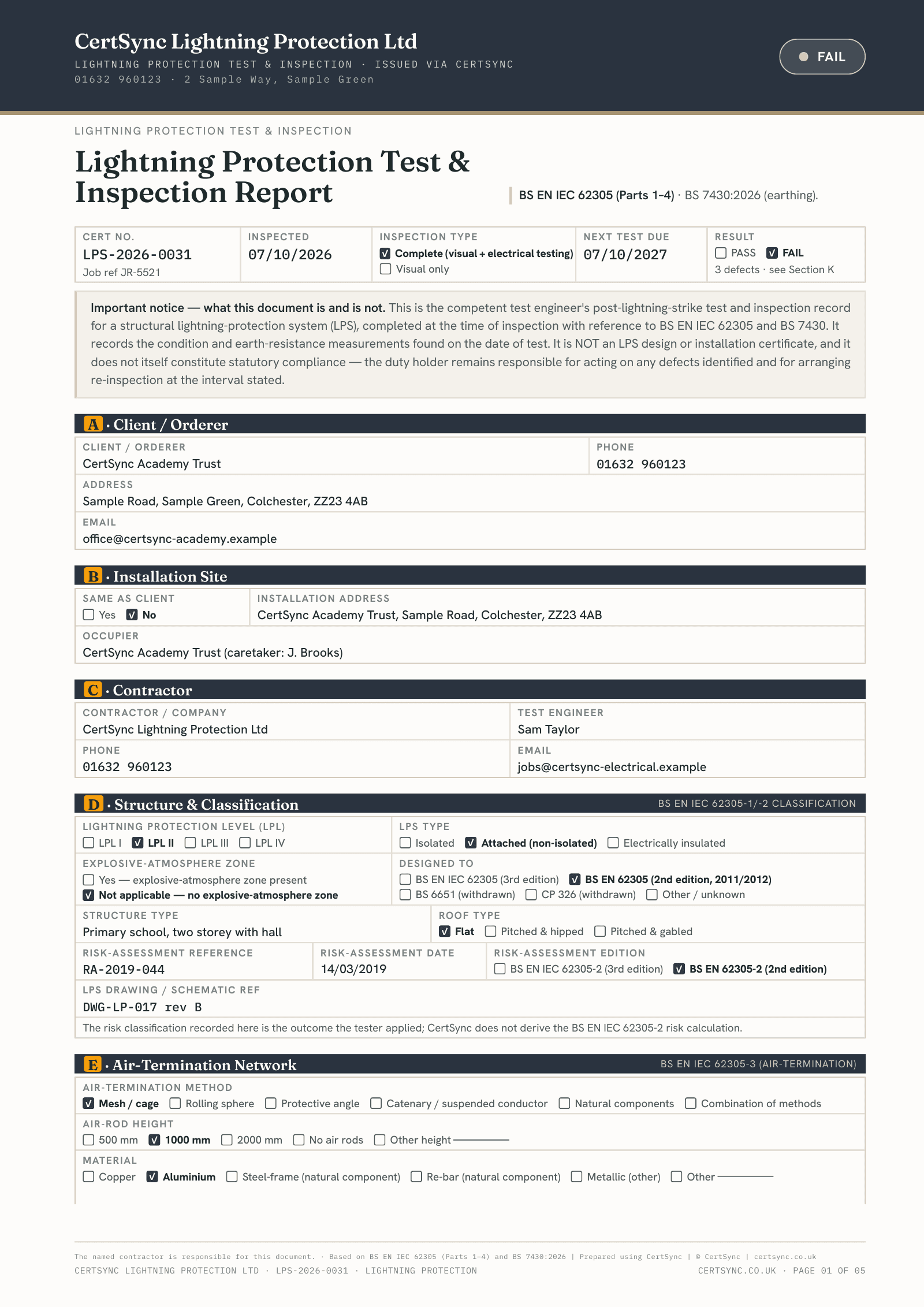
What this certificate includes
- The structure section records the structure and roof type, the kind of system (isolated, attached or electrically insulated), the standard it was designed to, from CP 326 and BS 6651 through to BS EN IEC 62305, the Lightning Protection Level, the LPS drawing reference, and the reference, date and edition of the risk assessment the level came from.
- The design standard must be recorded before the report can be issued. A Lightning Protection Level from I to IV is then required for a system designed to the BS EN IEC 62305 series, and for one designed to BS 6651, CP 326 or another earlier standard the report prints that a level does not apply, rather than leaving a blank.
- Every report records why the inspection happened: during construction, on completion, periodic, after an alteration, or after a known lightning strike. It cannot be issued until one is chosen, and the wording of the report names that occasion.
- Each occasion asks its own questions: whether parts were inspected before being covered on a construction visit, what was altered and by whom, or the strike date (or that it is not known) and whether damage was found.
- You record whether the inspection was visual only or complete with electrical testing. A visual report changes its title and declaration and states that no earth-resistance testing was carried out, so it never claims readings that were not taken.
- A complete inspection cannot be issued without at least one earth-electrode reading, the overall earth resistance, and the make and calibration date of the earth-resistance tester.
- The earth-electrode table takes one row per electrode: reference, resistance, ground type and condition, electrode type and size, test facility, test method (fall-of-potential, clamp-on or dead-earth) and a pass, fail or unable-to-test result. An over-range meter reading is kept exactly as shown.
- If the overall earth resistance is higher than the lowest single electrode reading, which electrodes in parallel cannot produce, it is flagged before you issue. Where the overall figure is recorded as measured through the connected system, it is shown as an advisory instead.
- You must answer whether the structure contains an explosive-atmosphere zone. The answer decides whether the overall earth resistance is judged as a mandatory limit or as an advisory target, and a yes opens a section for the zones, bonding checks and work permit.
- Concealed joints and bonds each get their own row with a reference, the measured continuity and your judgement of satisfactory or not. No pass mark is applied to these rows: the decision is the engineer’s.
- Surge protective devices are listed one per installation point, with location, installation type, type or model and condition. A failed SPD or too few down conductors under an overall PASS is flagged before you issue; when the overall result is recorded as FAIL, those findings are carried as advisories so the failing report can still be issued.
- The visual condition section asks about damage, corrosion, alterations, extensions and bonding. On an electrically insulated system the separation-distance question is replaced by one about whether the insulation is adequate.
- The declaration has a test engineer and a reviewer, each with name, signature and date. The test engineer’s name and signature are needed before issue.
- The next inspection date is filled in twelve months ahead and can be changed. It is left blank for a during-construction visit, and a date on or before the inspection date stops the report being issued.
- Once the certificate is issued, CertSync records when its re-inspection falls due, lists it in the Renewals due panel on your dashboard and emails you 90, 30 and 7 days before that date.
Domestic, commercial and industrial use
Domestic use
Domestic structures are covered by BS EN IEC 62305 on exactly the same basis as commercial or industrial buildings — a house assessed as high-risk by the BS EN IEC 62305-2 risk assessment can carry the same Lightning Protection Level as a much larger commercial structure. CertSync records the LPL and the supporting risk-assessment outcome for any structure type.
Commercial use
Commercial premises — offices, retail, places of assembly — are assessed individually against BS EN IEC 62305-2's risk factors (structure size, occupancy, contents, location). CertSync records the resulting LPL and the earth-electrode and down-conductor test results for the installed system.
Industrial use
Industrial structures — factories, plant with hazardous contents, tall or isolated buildings — often carry a higher risk score and a correspondingly higher LPL. CertSync records type A, type B, natural and combined earth-termination arrangements, and fall-of-potential, clamp-on or dead-earth readings.
Frequently asked questions
- Does lightning protection certification differ for domestic vs commercial buildings?
- No — BS EN IEC 62305 applies identically across domestic, commercial and industrial structures. The Lightning Protection Level (LPL I to IV), set by a BS EN IEC 62305-2 risk assessment, does the differentiation that a separate sector rule would otherwise do — a small domestic building assessed as high-risk can carry the same LPL as a large commercial one.
- What is the Lightning Protection Level (LPL) and how is it decided?
- The Lightning Protection Level (LPL I, the most stringent, through to LPL IV) sets the protection efficiency a system must achieve. It is determined by a risk assessment under BS EN IEC 62305-2, which weighs factors including the structure's size, use, contents and location. It is a different classifier from the class of LPS, the construction specification selected to deliver that level. CertSync records the assigned level, the kind of system and the standard it was designed to. For a system designed to BS 6651 or CP 326 an LPL may not apply, so the level is optional.
- How often does a lightning protection system need re-testing?
- The UK professional expectation is every 12 months, whatever the LPL. That is the practical means of meeting the duty to maintain under the Electricity at Work Regulations 1989 regulation 4(2), which sets no interval of its own. More frequent inspection may be needed on higher-risk sites, after a suspected strike, or where your insurer requires it. CertSync pre-fills the next-due date 12 months ahead, you can change it, and you get reminder emails as it approaches.
- What changed in the 3rd edition of BS EN IEC 62305?
- The 3rd edition (2024/2025) — redesignated BS EN IEC 62305, with "IEC" in the title — replaced flash density with strike-point density as the risk-assessment input, merged the previous multi-risk model into a single-risk concept, and added a risk-reduction credit for thunderstorm-warning systems under IEC 62793. CertSync records which edition the risk assessment and the inspection were carried out under.
- Does BS 7430:2026 affect my earth-electrode testing?
- BS 7430:2026 is the UK code of practice for protective earthing that underpins earth-electrode resistance testing, and it supersedes the 2011 edition. CertSync's earth-electrode test fields follow current earthing testing practice, aligned to this edition.
- Can I keep a lightning protection report with the customer’s EICR?
- Yes. Start the report for a saved customer and it sits on their record alongside their other certificates, such as an EICR or EIC, and their contact details fill in from their last certificate.
Related certificates and guides
Get started with CertSync
Start free — first month on us. All 13 certificate types, one subscription.
First month free, card required, then From £15/month. No fixed-term contract. Cancel any time.