Certificate type
Emergency Lighting Certificate software
BS 5266-1:2025
Emergency lighting certificates record the design, installation, commissioning and periodic testing of emergency lighting systems. BS 5266-1:2025 sets out the requirements for premises where emergency lighting is mandated — providing illumination for safe evacuation when the normal supply fails. CertSync produces the certificate in a structured form covering luminaire schedules, battery test results and duration test records.
What is an emergency lighting certificate?
An Emergency Lighting certificate records the design, installation, commissioning or periodic testing of an emergency lighting system to BS 5266-1:2025. Emergency lighting provides illumination of escape routes and safety equipment when the normal supply fails, so people can evacuate safely.
Key features
- Luminaire schedule — records each emergency luminaire, its location, type and battery duration rating
- Duration test records — documents annual three-hour duration tests and monthly functional checks
- Fire risk assessment reference — records the reference and date of the assessment the design was based on
- System type recording — central battery, self-contained or maintained/non-maintained system classification
- Photo evidence — attach images of luminaire positions, signs and test equipment readings
- Digital signature and PDF — signed certificate ready to hand to the responsible person or facilities manager
How is the certificate printed, sent and checked?
- The sign-off and declaration sit on page 1, with the detailed records after them.
- Every option on the form is printed, with your answer ticked, so the reader sees what was chosen and what was not.
- The footer reads "Prepared using CertSync", and the certificate states that the contractor named on it is responsible for its contents.
- Print a QR sticker for the installation. Scanning it opens a public verification page that asks for the property postcode and keeps the customer’s personal details hidden.
- Email the signed PDF to your customer from the app. Sending needs a connection.
The issued certificate
See a real emergency lighting certificate
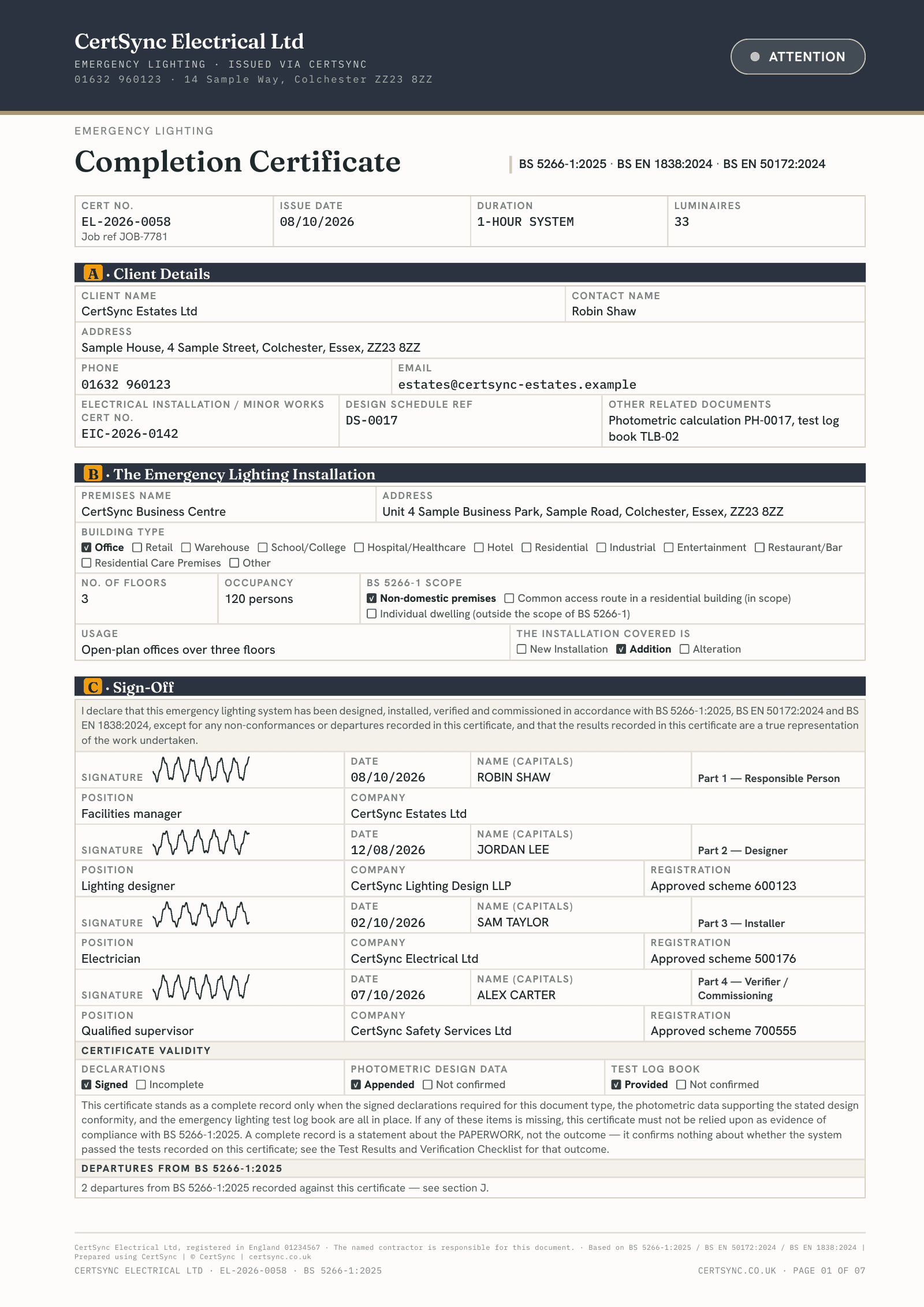
What this certificate includes
- Choose one of three documents at the start: a Completion Certificate for a new installation, addition or alteration, a Verification Certificate for an existing installation with no valid completion certificate, or a Periodic Inspection & Testing Certificate.
- Every certificate asks whether the premises are non-domestic, a common access route in a residential block, or an individual dwelling. BS 5266-1:2025 does not cover an individual dwelling, so that answer stops the certificate being issued.
- A 1-hour duration needs the evacuation strategy and whether the premises are reoccupied before the batteries recharge. If those answers do not support it, or the premises are a residential common access route, the certificate cannot be issued at 1 hour.
- The luminaire schedule records each fitting’s location, floor, type, make and model, lamp, wattage, operating mode, mounting height, measured lux, rated duration, test date and result, with serial number, asset tag and battery details on a line beneath.
- Test results cover the visual inspection, the short-duration and full-duration tests with their dates, the switchover test, which luminaires failed, battery condition and recovery after discharge, and the test equipment with its calibration date.
- Switchover can be recorded as two measured times, to half and to full emergency illuminance, plus a separate time for high-risk task areas. The form records the readings beside your own pass or fail; it does not apply a threshold of its own.
- A completion or verification certificate cannot be issued with a failed full-duration test. A passed one while a luminaire in the schedule is rated below the system’s duration is flagged before you issue.
- A completion certificate carries four signed parts: the responsible person, the designer, the installer and the verifier. If the responsible person cannot sign on site, you can record that, and the certificate prints that their signature is outstanding.
- Design, installation and verification checklists are answered C, NC or N/A, each row with its BS 5266-1 clause. On a completion or verification certificate, an NC must be justified as a recorded departure before it can be issued.
- A completion certificate needs the initial photometric verification taken with a lux or luminance meter: the date, the instrument and its serial number, and when the next verification is due.
- Completion and verification certificates need the photometric design data recorded as appended and the test log book recorded as handed over, because the standard treats the certificate as incomplete without them.
- A periodic report states whether it records a commissioning, monthly or annual test, the extent of the inspection, the overall condition and the next inspection date. It cannot be marked Satisfactory while it records a failure.
- When a periodic report records a failure, it cannot be issued without a fault action row saying what was done to safeguard the premises and to put the system right, and who signed for it. The row also takes the dates of failure and repair, and a repair dated before its failure is refused.
- The notes for the recipient explain that a full-duration test drains the batteries, what to do when a test fails, and that the log book is kept by the person responsible for the premises.
- On commercial and industrial premises, once the certificate is issued, CertSync records when its re-inspection falls due, lists it in the Renewals due panel on your dashboard and emails you 90, 30 and 7 days before that date. Emergency lighting in a dwelling gets no reminder.
Domestic, commercial and industrial use
BS 5266-1:2025 does not apply to individual domestic dwellings. Emergency lighting is not a regulatory requirement for a single house or flat. The standard covers commercial premises, industrial premises, and the shared or common areas of residential buildings such as blocks of flats, HMOs, care homes and sheltered housing.
Commercial use
Commercial premises — offices, retail units, restaurants, hotels, leisure facilities and places of public assembly — are within scope of BS 5266-1:2025. Emergency lighting is required to illuminate escape routes, safety equipment locations and signs when the normal lighting supply is interrupted. CertSync records the luminaire schedule, test results and the competent person's assessment for commercial installations of any size.
Industrial use
Industrial premises — factories, warehouses, plant rooms and workshops — require emergency lighting to enable safe evacuation from working areas and to illuminate safety equipment locations. BS 5266-1:2025 applies to these environments and CertSync supports the full range of system types and test formats encountered in industrial settings.
Certificates we produce
Documents we produce (BS 5266-1:2025)
- Completion Certificate — design, installation and commissioning declarations (small-premises variant for systems of 25 luminaires or fewer)
- Verification Certificate — for verifying an existing installation
- Periodic Inspection & Testing Certificate — for routine monthly and annual duration tests
How to complete an emergency lighting certificate in CertSync
The Emergency Lighting wizard begins by choosing the document type, then records the system, the luminaire schedule, design and installation checks, and the test results.
- Client DetailsUnder Certificate Type choose the Document Type: Completion Certificate, Verification Certificate or Periodic Inspection & Testing Certificate. A completion certificate also asks for the Completion Extent and whether it is a small premises. Then enter the client details and the job details.
- Premises DetailsEnter the premises address and building information, including the Premises Scope.
- System ConfigRecord the System Type, Duration Rating, evacuation strategy and the supply type, the number of luminaires and exit signs, the self-test arrangement, and any central battery details.
- Luminaire ScheduleAdd each luminaire to the schedule with its location and type.
- DesignWork through the Design Checklist and Design Details: lux levels, spacing calculation, design drawings, risk assessment reference and standard editions.
- InstallationComplete the Install Checklist and Install Details: cabling, wiring system and installation dates.
- VerificationComplete the verification checks.
- Test ResultsRecord the Test Equipment, Visual Inspection, Duration Tests, Switchover Test and Battery Condition (including the Recharge / Recovery Period in hours). A periodic certificate adds the Periodic Assessment.
- DeclarationsSign the declarations.
- Photos & Supporting DocumentsAttach photos and supporting documents.
- Handover & DocsComplete the Documentation Checklist and Handover Details, record any Variations from BS 5266-1, and capture the Client Acknowledgement.
BS 5266-1 does not apply to an individual dwelling. It does cover commercial and industrial premises and the common escape routes of blocks of flats, HMOs, care homes and sheltered housing; record that under Premises Scope.
Frequently asked questions
- Does my domestic property need an emergency lighting certificate?
- No. BS 5266-1:2025, which governs emergency lighting, does not apply to individual domestic dwellings — houses, flats or maisonettes occupied as a single private home. Emergency lighting certificates are required for commercial premises, industrial premises, and the shared or common areas of residential buildings such as the corridors and stairwells of a block of flats, an HMO, a care home or sheltered housing.
- How often does an emergency lighting system need to be tested?
- BS 5266-1:2025 requires a brief functional check each month and a full rated-duration test annually (typically three hours for systems with a three-hour rated duration). Each periodic report states whether it records a commissioning, monthly or annual test; the ongoing record stays in the site log book.
- What is the difference between a maintained and a non-maintained emergency luminaire?
- A maintained luminaire operates continuously — both during normal conditions and when the mains supply fails. A non-maintained luminaire only illuminates when the normal supply is interrupted. The distinction affects the design of the system and the appropriate locations for each type. CertSync records the system type and luminaire classification as part of the luminaire schedule.
- What is the three-hour duration test and why does it matter?
- Most emergency lighting systems are rated to provide light for three hours after a supply failure. The annual full-duration test confirms the batteries still hold their rated charge for that period. CertSync records the test date, whether the system achieved its rated duration, and any notes, so the responsible person has documented evidence of the result.
- Do shared areas of a block of flats need emergency lighting?
- Yes — the common corridors, stairwells and escape routes of a block of flats, an HMO or sheltered housing fall within the scope of BS 5266-1:2025, even though the individual private dwellings do not. CertSync handles these shared-area installations within the same certificate workflow as commercial premises.
- Can CertSync record both the installation and the periodic tests?
- Yes. CertSync supports completion certificates for new or modified systems and periodic test certificates for routine testing, so the full lifecycle of an emergency lighting system can be documented from one account, with client and site details carried forward between visits.
- How do I complete an Emergency Lighting certificate in CertSync?
- The Emergency Lighting wizard begins by choosing the document type, then records the system, the luminaire schedule, design and installation checks, and the test results. The steps are: Client Details; Premises Details; System Config; Luminaire Schedule; Design; Installation; Verification; Test Results; Declarations; Photos & Supporting Documents; Handover & Docs.
- Which emergency lighting certificate should I choose: completion, verification or periodic?
- Choose Completion for a new installation, addition or alteration, Verification for an existing installation checked against the current standard where no valid completion certificate exists, and Periodic Inspection & Testing for the recurring test of a commissioned system. On a periodic certificate you also record which test it documents: commissioning, monthly short duration or annual full duration.
Related certificates and guides
Get started with CertSync
Start free — first month on us. All 13 certificate types, one subscription.
First month free, card required, then From £15/month. No fixed-term contract. Cancel any time.