Certificate type
PAT testing record software (Portable Appliance Testing)
IET Code of Practice for In-service Inspection and Testing of Electrical Equipment, 5th edition · Electricity at Work Regulations 1989
PAT testing records the in-service inspection and testing of portable electrical equipment, providing a documented basis for the employer's duty to maintain electrical equipment in a safe condition under the Electricity at Work Regulations 1989. The IET Code of Practice for In-service Inspection and Testing of Electrical Equipment, 5th edition, is the industry-recognised guidance. CertSync structures the certificate to capture all required test results, equipment details and visual inspection findings in one professional document.
What is a PAT testing record?
A PAT (Portable Appliance Testing) record, printed as an In-Service Inspection & Testing Record, documents the in-service inspection and testing of portable and transportable electrical equipment. It documents the visual inspection and electrical tests for each appliance and gives a clear pass, fail or not-checked result, evidencing what was checked and whether it is safe to use.
Key features
- Pass/fail record per appliance — records visual inspection, earth continuity, insulation resistance and equipment class
- Many appliances on one certificate — record them one by one, or import an appliance list from a spreadsheet (CSV)
- Visual inspection checklist — structured prompts covering the socket-outlet, plug, flex, fuse, casing, switch, flex grip, signs of overheating, suitability for the environment and user-reported problems
- Test instrument details — records the instrument used, its serial number and calibration date
- Equipment location recording — notes the room or area where each appliance is located for re-identification
- PDF and email delivery — the signed record ready to send to the duty holder on completion
How is the certificate printed, sent and checked?
- Every option on the form is printed, with your answer ticked, so the reader sees what was chosen and what was not.
- The footer reads "Prepared using CertSync", and the certificate states that the contractor named on it is responsible for its contents.
- Print a QR sticker for the installation. Scanning it opens a public verification page that asks for the property postcode and keeps the customer’s personal details hidden.
- Email the signed PDF to your customer from the app. Sending needs a connection.
The issued certificate
See a real PAT testing record
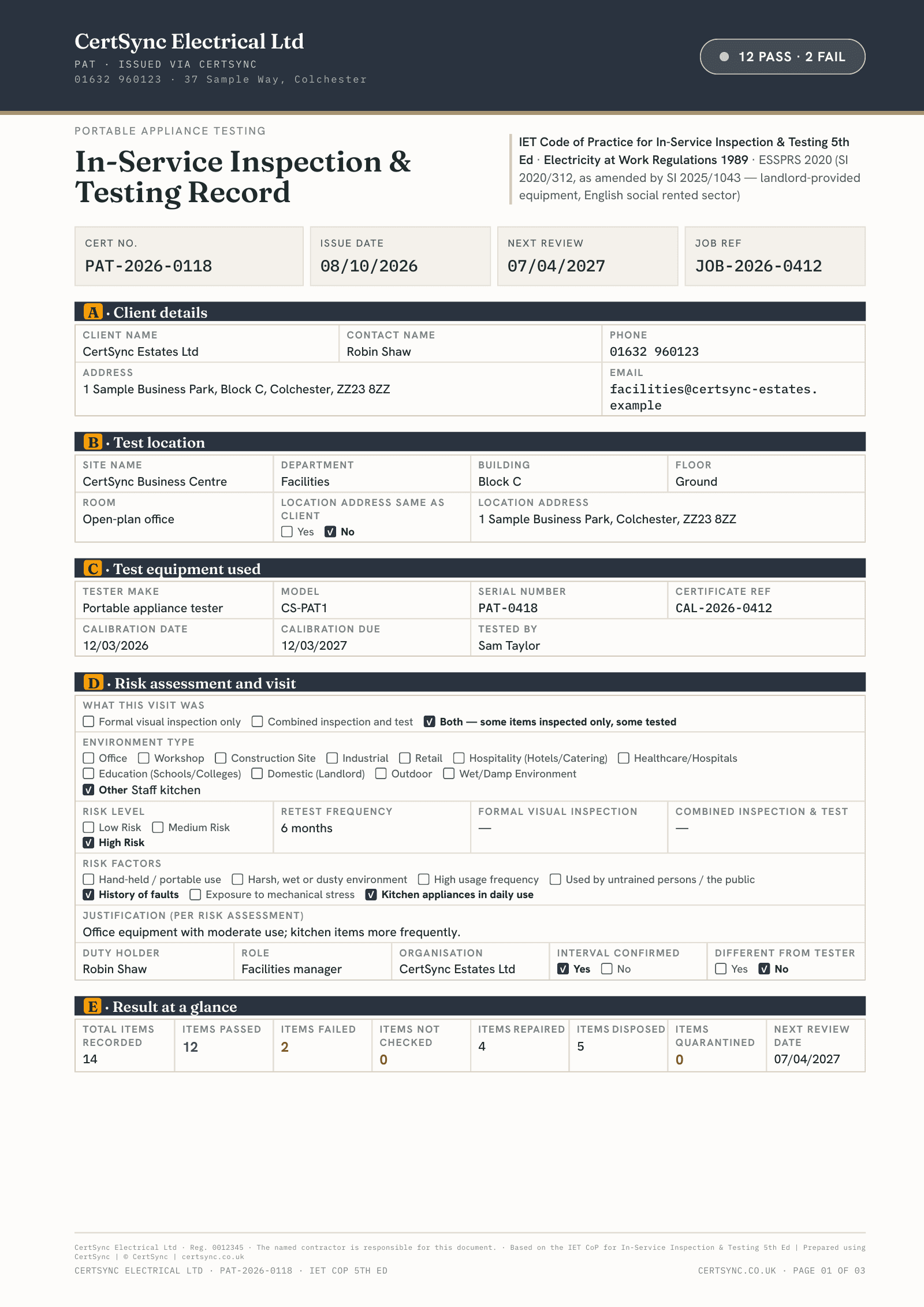
What this certificate includes
- Each appliance in the register records its asset ID, description, location, make, model and serial number, supply voltage, rating and fuse, and its equipment class (I, II, II FE or III) and type. Every item must be classified before issue, because the class decides which tests apply.
- The visual inspection covers the socket, plug, flex, fuse, body, switch, flex grip and signs of overheating, whether the item suits its environment, and whether the user has reported any problems, with room for anything else found.
- Suitability for the environment can be marked as limited when the item was inspected away from where it is used, which is a different answer from not checked.
- The electrical tests record earth continuity, both as measured and with the lead deducted, insulation resistance with the test voltage used, protective conductor current and touch current as separate readings, polarity, a load test, a user-defined test, and for a portable RCD its trip tests and a no-trip test at half its rating.
- The earth continuity limit takes the supply lead’s length and cross-sectional area into account. An appliance marked PASS with a reading above that limit stops the record being issued.
- Insulation resistance is judged against the minimum for the appliance’s class, with a separate figure for Class I heating or cooking equipment the tester flags. A PASS over a reading below the minimum, or over a leakage reading above the limit, blocks issue.
- Extension leads, adaptors and detachable appliance leads record their core count. A 2-core extension lead, adaptor or portable RCD cannot be marked PASS, and an RCD on a lead or adaptor rated above the maximum cannot pass either.
- Every appliance needs a result (pass, fail or not checked) before issue, and an appliance marked PASS while one of its own recorded checks failed is refused.
- A failed appliance records the reason, the action taken (repaired, replaced, disposed of or quarantined), a repair code and photos. The photos print on the photo pages captioned with the appliance they belong to, and quarantined items are called out on the summary page.
- The printed register shows protective conductor current for Class I items and touch current for Class II items in one leakage column, each marked so the reader knows which was measured.
- The test instrument is recorded with its make, model, serial number, calibration certificate reference, calibration date and due date. A record cannot be issued on an instrument whose calibration has expired.
- The risk assessment records the environment, risk level and risk factors, and the retest interval or a decision that formal visual inspection alone is needed. It names the duty holder and whether they confirmed the interval, and picking an environment suggests an interval you can change.
- You record whether the visit was a formal visual inspection, a combined inspection and test, or both. On a visual-only visit the tester declaration says no combined inspection and test was carried out.
- Appliances can be added one at a time with a quick-add row, or imported from a CSV file, where an asset ID already on the register is reported rather than added twice. Selected items can be duplicated or given a next test date together.
Domestic, commercial and industrial use
Domestic use
Domestic PAT work typically arises in HMOs, furnished rental properties and care homes where the landlord or operator has a duty to maintain portable appliances in a safe condition. CertSync lets you record many appliances on one certificate, or import an appliance list from a spreadsheet (CSV), so a single certificate can cover all the appliances in a property.
Commercial use
Commercial PAT testing is one of the most common repeat jobs for electrical contractors — offices, schools, hotels, retail premises and public buildings all require periodic in-service inspection of their portable equipment. CertSync lets you record many appliances on one certificate, or import an appliance list from a spreadsheet (CSV), and can carry client details forward for repeat visits.
Industrial use
Industrial PAT work often involves Class I power tools, extension leads and production equipment operating in demanding environments. Higher-risk equipment classes and shorter recommended test intervals apply in many industrial settings. CertSync records equipment class and type for each appliance, and the calibrated instrument used for the visit.
How to complete a PAT record in CertSync
The PAT wizard sets up the job, then records each appliance on its own card in an appliance register.
- Contractor & Client DetailsEnter the client, a job or reference number and the contact person.
- Test EquipmentRecord the Test Location (tick Same as client address if it is), then the Test Equipment Calibration: PAT Tester Make and Model, Serial Number, Last Calibration Date, Calibration Due Date and the calibration certificate reference.
- Risk AssessmentChoose the Environment Type and Risk Level, then record the Retest Frequency (months) and, if you wish, a justification. The duty holder (the person responsible for the equipment) is recorded here too.
- Appliance RegisterAdd each appliance, either one at a time with Quick Add Appliance or by importing a CSV. Each card has Identification, Visual Inspection, Electrical Tests and Result & Action sections. Record the appliance class first: the tests shown depend on it.
- Photos & Supporting DocumentsAttach photos and supporting documents.
- Declaration & ReviewComplete the summary and recommendations, the tester details and the Tester Signature, then the Client Signature.
Record the class before anything else on an appliance. Until you do, the card shows a prompt instead of test rows, because the limits come from the class.
Frequently asked questions
- Is PAT testing a legal requirement?
- No. HSE states plainly that the Electricity at Work Regulations 1989 do not make inspection or testing of electrical appliances a legal requirement, and do not require it to be done annually. What the Regulations do require is that electrical equipment is maintained, so far as is reasonably practicable, to prevent danger. In-service inspection and testing is the industry-recognised way of demonstrating that maintenance, and for much low-risk equipment HSE says a portable appliance test is not needed at all. There is no legal requirement to label equipment or to keep records, though records support the due-diligence defence. One statutory exception applies in England: since 1 November 2025 (new tenancies) and 1 May 2026 (existing ones), registered providers of social housing must have landlord-provided electrical equipment checked at least every 5 years and before each tenancy, and must obtain a written record of the results and the date of the next check.
- What equipment does PAT testing cover?
- PAT testing covers portable and transportable electrical equipment — items that are plugged into the mains supply and can be moved during normal use. This includes computers, kettles, floor lamps, extension leads, power tools and similar items. It also covers fixed electrical equipment such as hand dryers or water heaters; the fixed wiring itself is inspected under BS 7671.
- How long should PAT records be kept?
- There is no legal requirement to keep PAT records at all — HSE says so directly. Records are nonetheless worth keeping: they are what supports a due-diligence defence and they let the duty holder see how equipment is deteriorating between checks. CertSync keeps your certificates in secure cloud storage while your account is active, accessible at any time from the dashboard, and for a 90-day read-only grace period if you cancel — export your own copies during that window, because the data is permanently deleted on day 91.
- How often does equipment need PAT testing?
- For most equipment there is no legally fixed interval. The appropriate frequency depends on the type of equipment and the environment it is used in — a power tool on a construction site is checked far more often than a desktop computer in an office. The IET Code of Practice 5th Edition does not publish an interval table (the previous edition's table was withdrawn and not replaced); HSE's HSG107 and INDG236 give suggested intervals, and HSG107 states those are not legal requirements. The duty holder decides the schedule, on their own risk assessment. The one exception is landlord-provided equipment in the English social rented sector, which has a statutory maximum of 5 years plus a check before each tenancy.
- Can I test a large number of appliances on one certificate?
- Yes. Record many appliances on one certificate, or import an appliance list from a spreadsheet (CSV), so a single certificate can cover an entire inventory of appliances — useful for offices, schools, hotels and rental properties. Each appliance has its own entry with its test results, equipment class and location for re-identification.
- What test instrument details does a PAT record include?
- A robust PAT record identifies the instrument used, its serial number and its calibration date, so the results can be traced to a properly calibrated tester. CertSync captures these instrument details as part of the certificate, alongside the per-appliance results.
- How do I complete a PAT record in CertSync?
- The PAT wizard sets up the job, then records each appliance on its own card in an appliance register. The steps are: Contractor & Client Details; Test Equipment; Risk Assessment; Appliance Register; Photos & Supporting Documents; Declaration & Review.
- What do N/A, N/C and LIM mean on a PAT record?
- N/A means an item does not apply to the appliance and N/C means it was not checked. LIM is offered on most test readings (not insulation resistance), where it needs a reason saying why you could not complete the test, and on the environment suitability row, where it means you could not judge whether the appliance suits the place it is used; that judgement is then the duty holder’s.
Related certificates and guides
Get started with CertSync
Start free — first month on us. All 13 certificate types, one subscription.
First month free, card required, then From £15/month. No fixed-term contract. Cancel any time.