Certificate type
Solar PV Commissioning Certificate software
BS 7671:2018+A4:2026 §712 · IET Code of Practice for Grid-Connected Solar PV, 2nd edition · BS EN 62446-1
The Solar PV Commissioning Certificate records the installation and commissioning of a grid-connected solar photovoltaic system, confirming the work meets BS 7671 §712 and the IET Code of Practice for Grid-Connected Solar PV. It captures the string and inverter test results, the DNO connection pathway, and the electrical safety checks specific to a generating installation — alongside, not instead of, the conventional EIC for the supply circuit.
What is a solar PV commissioning certificate?
A Solar PV Commissioning Certificate records that a grid-connected solar photovoltaic installation has been designed, installed and commissioned to BS 7671 §712 and the IET Code of Practice for Grid-Connected Solar PV. It documents the string and inverter test results and the DNO connection pathway used to bring the array online.
Key features
- Multiple inverters per certificate — each string explicitly linked to the inverter it feeds
- Phase count (single or three) sets the limit the G98 route is checked against
- String test results (Voc, Isc) checked against the expected string figures, with deviation flagged as guidance
- AC and DC insulation resistance and Zs fields, export limitation, and how the array frame and the DC system are earthed
- DNO notification record — documents the G98/G99 connection pathway used
- Records the EIC number for the supply circuit, and any other generation at the supply (such as a battery inverter) so the G98 check counts it
How is the certificate printed, sent and checked?
- The sign-off and declaration sit on page 1, with the detailed records after them.
- Every option on the form is printed, with your answer ticked, so the reader sees what was chosen and what was not.
- The footer reads "Prepared using CertSync", and the certificate states that the contractor named on it is responsible for its contents.
- Print a QR sticker for the installation. Scanning it opens a public verification page that asks for the property postcode and keeps the customer’s personal details hidden.
- Email the signed PDF to your customer from the app. Sending needs a connection.
The issued certificate
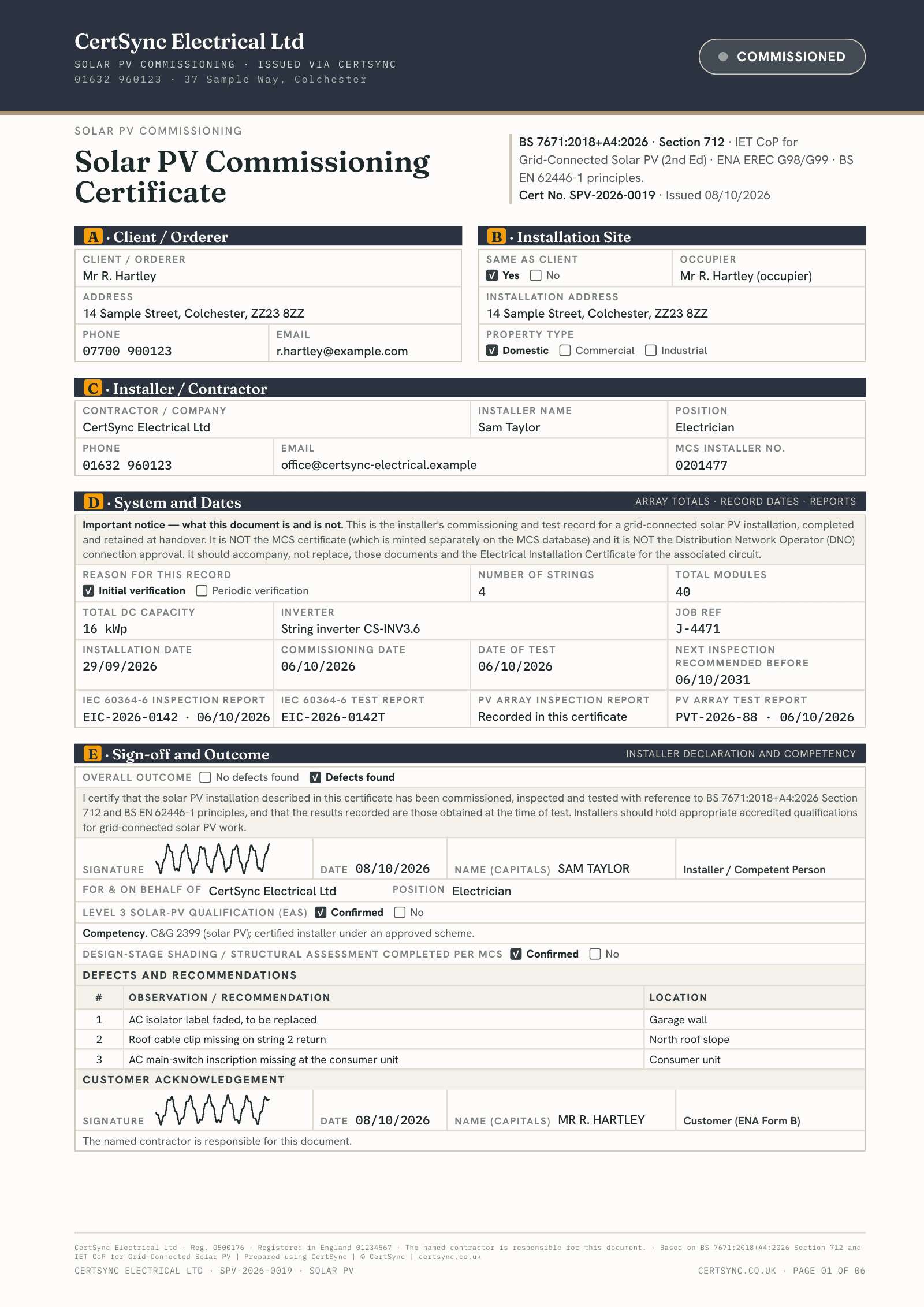
See a real solar PV commissioning certificate
What this certificate includes
- Inverters are a list, not a single box: each records its make, model, serial number, location, maximum DC input voltage, rated AC power and its G98 or G99 connection route, so a multi-inverter array goes on one certificate.
- Each string records the inverter it feeds. A string with DC test results that is not linked to an inverter stops the certificate being issued, because its open-circuit voltage cannot be checked against that inverter’s DC input.
- Each string records its module count, module make and model, nameplate Voc and Isc, cable type and size, overcurrent protection and its own DC isolator where it has one.
- The DC tests are recorded per string: measured Voc and Isc with the irradiance at the time, polarity, insulation resistance positive to earth and negative to earth with the test voltage used, and earth continuity.
- A string whose measured Voc is above its inverter’s maximum DC input voltage, whose DC insulation resistance is below the minimum for its voltage class, or whose polarity is wrong is flagged before you issue. Differences from the nameplate figures are shown as advisories.
- Once a G98 or G99 route is chosen, the supply must be recorded as single- or three-phase before issue. The phase count is not guessed.
- A G98 route is checked against the combined output of every inverter on the certificate plus any other generation already at the supply, phase by phase on a three-phase supply where each inverter’s phase is recorded. A G98 route the figures do not support is flagged before you issue.
- For a G99 connection the form records the application and approval references and dates, the approval status, the network operator’s protection settings schedule and the values programmed. Values recorded as not matching the schedule block issue; an approval still pending is flagged as a warning.
- Every inverter needs a loss-of-mains result recorded as pass or fail before issue, on G98 and G99 alike. A blank result is not treated as a pass, and a fail is flagged before you issue.
- The AC side records the number of phases, insulation resistance live to live and live to earth, polarity, earth fault loop impedance and the RCD. A reading below the BS 7671 Chapter 64 minimum, polarity recorded as not correct, or a failed RCD test is flagged before you issue.
- Where an RCD is fitted and its recorded type cannot detect smooth DC fault current, every inverter must be recorded as having AC/DC separation, or the exception evidenced with the device and its product standard; until then it is flagged before you issue.
- A BS EN 62446-1 Annex B inspection schedule is recorded item by item as confirmed, not confirmed or not applicable. An outcome of “no defects” cannot be issued beside a listed defect or an item marked not confirmed.
- The warning notices, the AC isolation switch and equipotential bonding are each recorded as present, absent or not applicable. Any recorded as absent stops the certificate being issued.
- The same form records an initial verification of a new array or a periodic verification of an existing one. Choosing periodic changes the certificate title and the declaration wording, so a re-verification is not presented as a first commissioning.
Domestic, commercial and industrial use
Domestic use
Domestic solar PV installations are typically a single inverter with one or more strings on a single-phase supply. CertSync records each string's test results against the inverter it feeds, and the G98 or G99 connection pathway used for the DNO notification.
Commercial use
Commercial solar PV arrays — roof-mounted retail and office installations, car-port canopies — commonly use multiple inverters and three-phase supplies. CertSync supports multiple inverters on one certificate, with each string explicitly linked to the inverter it feeds, so a multi-inverter array is recorded accurately rather than forced into a single-inverter form.
Industrial use
Industrial-scale solar PV — large roof arrays and ground-mount systems on factory or warehouse sites — typically involves higher DC voltages, three-phase connection and multiple inverters. CertSync's per-string, per-inverter structure and phase-count field scale to these larger installations without loss of detail.
Validation as you enter results
Built-in §712 / BS EN 62446-1 validation flags out-of-range values as you enter test results, with the relevant regulation reference. It assists the competent person and does not replace professional judgement.
Frequently asked questions
- Do I need a Solar PV certificate as well as an EIC?
- Yes, where the job includes a generating installation. The EIC certifies the electrical work to BS 7671. The Solar PV Commissioning Certificate additionally records the generation-specific elements — the string and inverter test results set out in BS 7671 §712 and the IET Code of Practice, plus a record of the DNO connection pathway, which is set by the ENA Engineering Recommendations G98 and G99 rather than by BS 7671 itself. The Solar PV certificate records the EIC number for the supply circuit.
- What is the difference between a G98 and a G99 connection?
- G98 and G99 are ENA Engineering Recommendation connection pathways for generating equipment. G98 applies to smaller installations up to a defined capacity per phase, with factory-fixed protection settings. G99 applies above that threshold and requires a DNO-issued, project-specific settings application. The distinction is a capacity threshold, not a domestic-versus-commercial split — a small three-phase commercial array can still qualify for G98.
- Does CertSync support arrays with more than one inverter?
- Yes. Commercial and industrial solar PV installations frequently use multiple inverters. CertSync records each string against the specific inverter it feeds, so a multi-inverter array is documented accurately rather than compressed into a single-inverter form.
- What test results does a Solar PV certificate record?
- The certificate records per-string open-circuit voltage (Voc) and short-circuit current (Isc) results, AC and DC insulation resistance, earth fault loop impedance where applicable, and polarity checks — the commissioning tests set out in BS EN 62446-1 and the IET Code of Practice for Grid-Connected Solar PV.
- Is a Solar PV certificate needed for a battery-only retrofit?
- No — a battery storage system installed without new PV generation is certified on a Battery/EESS Commissioning Certificate instead. Where a job combines new solar PV with battery storage, issue both: the battery certificate records the paired Solar PV certificate number, and the Solar PV certificate can record the battery inverter as other generation at the supply.
- How does DNO notification work for a solar PV installation?
- Depending on the installation's capacity per phase, notification to the Distribution Network Operator follows either the G98 (installer self-certifies against factory-fixed settings) or G99 (DNO issues project-specific settings before connection) pathway. CertSync records which route applied, with the notification or approval references and dates.
Related certificates and guides
Get started with CertSync
Start free — first month on us. All 13 certificate types, one subscription.
First month free, card required, then From £15/month. No fixed-term contract. Cancel any time.