Certificate type
Minor Electrical Installation Works Certificate (MEIWC) software
BS 7671:2018+A4:2026
The MEIWC is the appropriate certificate for minor additions or alterations to an existing circuit — work that does not extend to providing a new circuit and therefore does not need a full EIC. Common examples include adding a socket-outlet or lighting point to an existing circuit, relocating a light switch, or replacing an accessory or luminaire. CertSync produces the certificate in a concise, correctly structured form that covers the circuit details and test results the competent person is required to record.
What is a Minor Electrical Installation Works Certificate (MEIWC)?
A Minor Electrical Installation Works Certificate (MEIWC) certifies a minor addition or alteration to an existing installation that does not extend to providing a new circuit — for example adding a socket to an existing ring, installing a new light fitting on an existing lighting circuit, or a like-for-like accessory change. It records the work, the relevant test results and the certifying person’s declaration. It is issued for one existing circuit; where minor work affects more than one circuit, each has its own certificate.
Key features
- Five lettered sections on the issued certificate — what was done, earth and bonding connections, the circuit and its protection, test readings, and sign-off
- BS 7671:2018+A4:2026 checks — Zs against the protective device and earthing arrangement, insulation resistance against its minimum, and RCD operating time, with every failing reading flagged before you issue; missing items and conflicts always block
- Existing installation details — records the earthing arrangement and supply characteristics of the installation being added to
- Digital signature — certifier signs on screen; certificate locks on signature and cannot be altered
- Cross-certificate memory — a saved customer’s details fill in from their last certificate, and their saved sites fill the installation address
- Signed PDF ready to email to the client or download once the certificate is complete
How is the certificate printed, sent and checked?
- Every option on the form is printed, with your answer ticked, so the reader sees what was chosen and what was not.
- The footer reads "Prepared using CertSync", and the certificate states that the contractor named on it is responsible for its contents.
- Print a QR sticker for the installation. Scanning it opens a public verification page that asks for the property postcode and keeps the customer’s personal details hidden.
- Email the signed PDF to your customer from the app. Sending needs a connection.
The issued certificate
See a real Minor Electrical Installation Works Certificate (MEIWC)
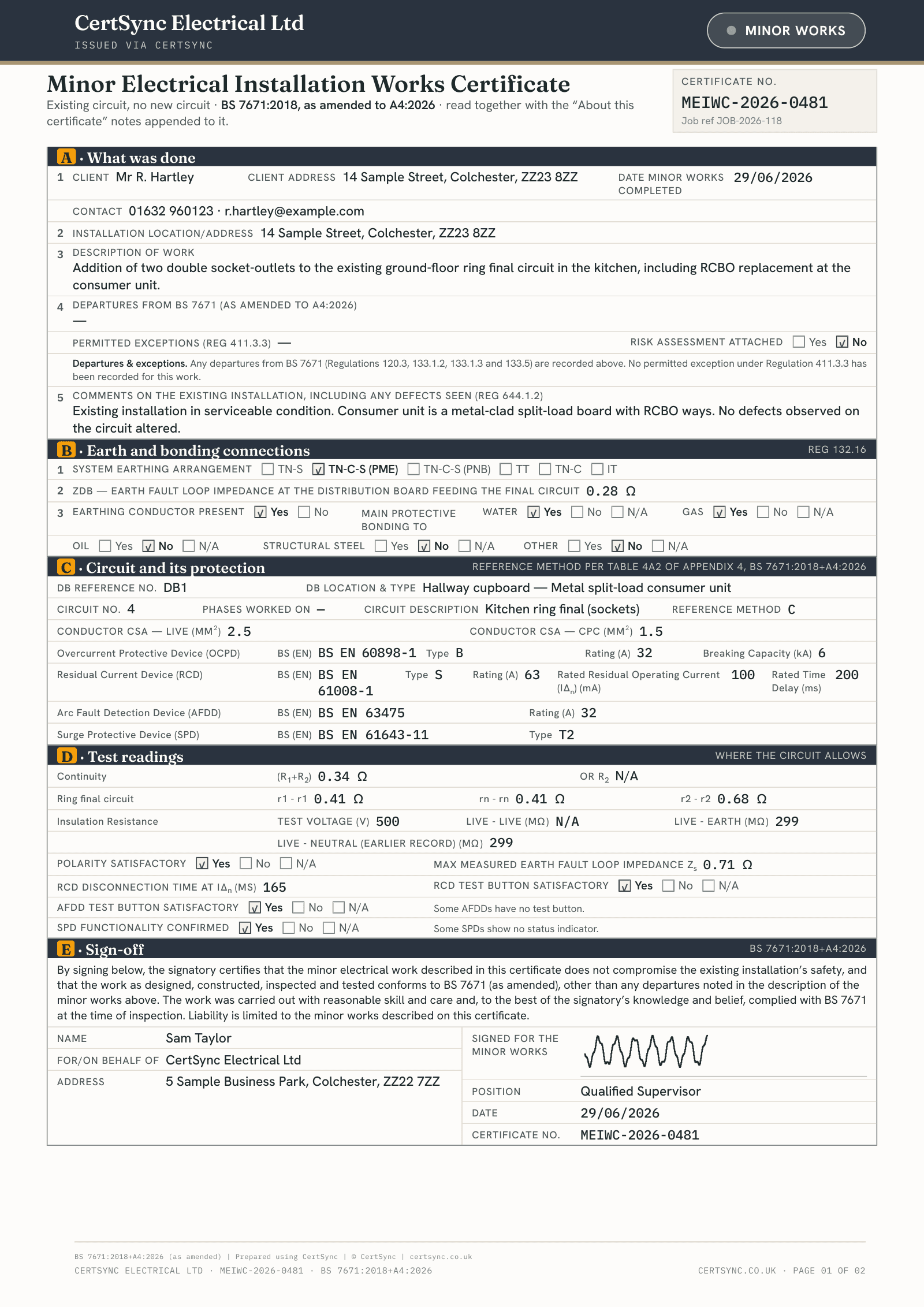
What this certificate includes
- Section A records the client, the installation address, the date the work was finished, a description of the work, any departures from BS 7671, any permitted exception under Regulation 411.3.3 with whether a risk assessment is attached, and comments on the existing installation.
- Page 1 states the scope in print: work on an existing circuit, no new circuit. The notes for the recipient explain that where a new circuit has been added, an EIC is the right document instead.
- Section B records the system earthing arrangement, the loop impedance at the board feeding the circuit, whether an earthing conductor is present, and main protective bonding to water, gas, oil, structural steel and any other service, each answered Yes, No or N/A.
- The earthing arrangement must be chosen and every bonding service answered before the certificate can be issued. The arrangement decides which BS 7671 rule the loop impedance is judged against.
- Section C records the one circuit worked on: its board, number and description, the phases worked on, the reference method, the live and cpc conductor sizes, and a line each for the overcurrent device, RCD, AFDD and SPD.
- Once you pick the protective device and its rating, the form shows the maximum permitted Zs for that device and the BS 7671 table it comes from, or says plainly when no limit can be worked out rather than guessing one.
- A measured Zs above the limit for the device and earthing arrangement stops the certificate being issued. So does an RCBO with a Zs recorded but no B, C or D trip curve, because its limit cannot be found without one.
- Section D records continuity, with the ring readings where the circuit is a ring, insulation resistance live to live and live to earth with the test voltage, polarity, the measured Zs, the RCD operating time and test button, and the AFDD and SPD checks.
- An insulation resistance reading cannot be issued without the test voltage it was taken at, and a reading below the BS 7671 Table 64 minimum is flagged before you issue. The reduced minimum applies only when you mark the circuit as SELV or PELV.
- An RCD operating time at its rated residual current that falls outside the time BS 7671 allows is flagged before you issue.
- Section E has a single signatory: name, company, address, position, signature and date, with an optional competent-person scheme and registration number. The name, signature and date are needed before issue.
- A saved circuit template can fill in the circuit and its protective devices, and the circuit on a Minor Works certificate can be saved as a template for the next job. The same templates work on EICs and EICRs.
- The installation postcode must be a valid UK postcode, because it is what someone scanning the certificate’s QR code enters to view it.
- Photos added to the certificate print on their own pages after the notes for the recipient, up to six to a page.
Domestic, commercial and industrial use
Domestic use
Most domestic minor works — adding a socket to an existing ring, fitting an extra lighting point on an existing lighting circuit, moving a switch — are captured on an MEIWC. Start the certificate for a saved customer and their details fill in from their last certificate, and pick one of their saved sites to fill the installation address, so repeat visits need little re-entry.
Commercial use
Commercial minor works such as additional outlets on an existing circuit, relocated luminaires or replacement accessories are typical MEIWC use cases. CertSync supports the commercial earthing arrangements and device types encountered in these environments.
Industrial use
Industrial minor works — extending an existing power circuit to serve an additional outlet, relocating a local isolator, or replacing an accessory in a production area — follow the same MEIWC form. CertSync records protective devices up to 1000 A, including BS EN 60947-2 MCCBs, and all six earthing arrangements.
Validation as you enter results
Built-in BS 7671 validation flags out-of-range values as you enter test results, with the relevant regulation reference. It assists the competent person and does not replace professional judgement.
How to issue a Minor Works Certificate
A Minor Works Certificate covers one existing circuit. The sequence is the same whether the job is one socket or a relocated switch.
- Check the job is minor workConfirm the work is an addition or alteration to one existing circuit. A new circuit or a consumer unit replacement needs an EIC instead.
- Check the existing circuitConfirm the circuit you are adding to, and its earthing and bonding, are in a fit state to take the addition.
- Carry out and test the workComplete the work, then test the circuit and record the readings, with live checks against the limits for the protective device you chose.
- Describe the work and signRecord what was done, the circuit and its protection, and any departures, then sign the declaration.
- Give the client the certificateEmail or hand over the signed PDF. Where the work affected more than one circuit, each circuit has its own certificate.
How to complete a Minor Works certificate in CertSync
The MEIWC wizard is deliberately short: it describes one piece of work on one existing circuit. The steps carry the same letters as the printed certificate sections.
- A · What was doneSay who the work is for, where it is and what you did (Description of the Minor Works). Record any comments on the existing installation and note any departures.
- B · Earth and bonding connectionsRecord the System Earthing Arrangement, measure Zdb at the board feeding the circuit, and confirm the main protective bonding.
- C · Circuit and its protectionDescribe the one circuit you altered: distribution board details, circuit information and the overcurrent protective device. RCD, AFDD and SPD cards are completed only if those devices are fitted.
- D · Test readingsEnter the readings from your tester for this circuit: continuity, ring final circuit readings where relevant, insulation resistance, polarity, Max. Measured Earth Fault Loop Impedance (Zs), and the RCD, AFDD and SPD checks. Use N/A where a test does not apply and LIM where it could not be done.
- Photos & Supporting DocumentsAttach photos and supporting documents.
- E · Sign-offConfirm your details, competent person scheme and registration number, then sign. Your details can be filled from your saved profile.
If you find yourself describing a second circuit, stop: that job needs its own Minor Works certificate, or an EIC if a new circuit is involved.
Frequently asked questions
- When should I use an MEIWC rather than an EIC?
- Use the MEIWC for minor additions or alterations to an existing circuit — an additional socket-outlet or lighting point, a relocated switch, a replacement accessory or luminaire. Use an EIC when the work provides a new circuit, constitutes a new installation, or replaces the consumer unit. If you are unsure which applies, BS 7671 guidance and the IET On-Site Guide describe the scope of each certificate in more detail.
- Does an MEIWC need the same test results as an EIC?
- The MEIWC requires the key test results for the circuit or work being certified — continuity (with ring readings where applicable), insulation resistance with its test voltage, polarity, Zs and, where fitted, RCD, AFDD and SPD checks. It does not require a full schedule of circuits for the whole installation. CertSync flags a Zs, insulation resistance or RCD time outside BS 7671 before you issue, and missing readings always block it.
- Can I attach photos to an MEIWC?
- Yes. Photos you add to an MEIWC print on their own pages at the back of the certificate, so you can record the completed work visually alongside the test results.
- Can I add a new circuit on an MEIWC?
- No. A new circuit run from the distribution board is outside the scope of the MEIWC and should be certified on an EIC. The MEIWC is for additions and alterations to existing circuits — extra outlets, replacement accessories, additional lighting points and similar minor work. If you are unsure, the IET On-Site Guide describes the boundary between the two certificates.
- Do I still need to test the existing circuit?
- Yes. Before certifying minor work you confirm that the existing circuit being added to is in a satisfactory condition to support the addition — including earthing and bonding, polarity and earth fault loop impedance as applicable. The MEIWC records these results for the circuit affected, and CertSync validates the values you enter.
- Is an MEIWC acceptable for a consumer unit change?
- A full consumer unit replacement is generally treated as work that warrants an EIC, because it affects the origin of the installation and every circuit it supplies. An MEIWC is appropriate for a minor accessory-level change. CertSync supports both documents so you can pick the correct one for the scope of the job.
- How do I complete a Minor Works certificate (MEIWC) in CertSync?
- The MEIWC wizard is deliberately short: it describes one piece of work on one existing circuit. The steps carry the same letters as the printed certificate sections. The steps are: A · What was done; B · Earth and bonding connections; C · Circuit and its protection; D · Test readings; Photos & Supporting Documents; E · Sign-off.
- What are the common mistakes on a Minor Works certificate?
- The usual mistakes are using Minor Works for work that needs an EIC, and covering several circuits on one certificate. The MEIWC wizard describes the single circuit you altered, so each circuit worked on gets its own certificate, and a new circuit, a consumer unit change or a rewire is EIC work.
Related certificates and guides
Get started with CertSync
Start free — first month on us. All 13 certificate types, one subscription.
First month free, card required, then From £15/month. No fixed-term contract. Cancel any time.