Certificate type
Fire Alarm Certificate software
BS 5839-6:2019+A1:2020 (domestic) · BS 5839-1:2025 (non-domestic)
Fire alarm certification covers both domestic detection systems, governed by BS 5839-6, and the comprehensive non-domestic document set under BS 5839-1:2025. CertSync produces a single combined certificate for domestic Grades C, D1, D2, F1 and F2, separate stage certificates for a domestic Grade A system, and the full Annex G suite of seven separate documents for non-domestic installations. Each is a distinct, signed certificate for its stage of the system’s life.
What is a fire alarm certificate?
A Fire Alarm certificate records the design, installation, commissioning or maintenance of a fire detection and alarm system. Domestic systems are certified to BS 5839-6, on a single combined document for most grades and on separate stage certificates for Grade A; non-domestic systems use the BS 5839-1:2025 Annex G set of seven lifecycle certificates.
Key features
- Domestic (BS 5839-6) — one combined certificate for Grades C, D1, D2, F1 and F2, and separate design, installation, commissioning, handover and modification certificates for Grade A
- Full BS 5839-1:2025 Annex G suite — all seven non-domestic certificate types as separate, individually signed documents
- Zone and device schedules — records detector locations, device types and zone boundaries
- Cause and effect — the drawing reference on the Commissioning certificate, and the full matrix, trigger by trigger, on the Handover certificate
- Sound level measurement records — dB measurements at specified locations per commissioning requirements
- Digital signature per document — each Annex G certificate is signed and locked independently
How is the certificate printed, sent and checked?
- Every option on the form is printed, with your answer ticked, so the reader sees what was chosen and what was not.
- The footer reads "Prepared using CertSync", and the certificate states that the contractor named on it is responsible for its contents.
- Print a QR sticker for the installation. Scanning it opens a public verification page that asks for the property postcode and keeps the customer’s personal details hidden.
- Email the signed PDF to your customer from the app. Sending needs a connection.
The issued certificate
See a real fire alarm certificate
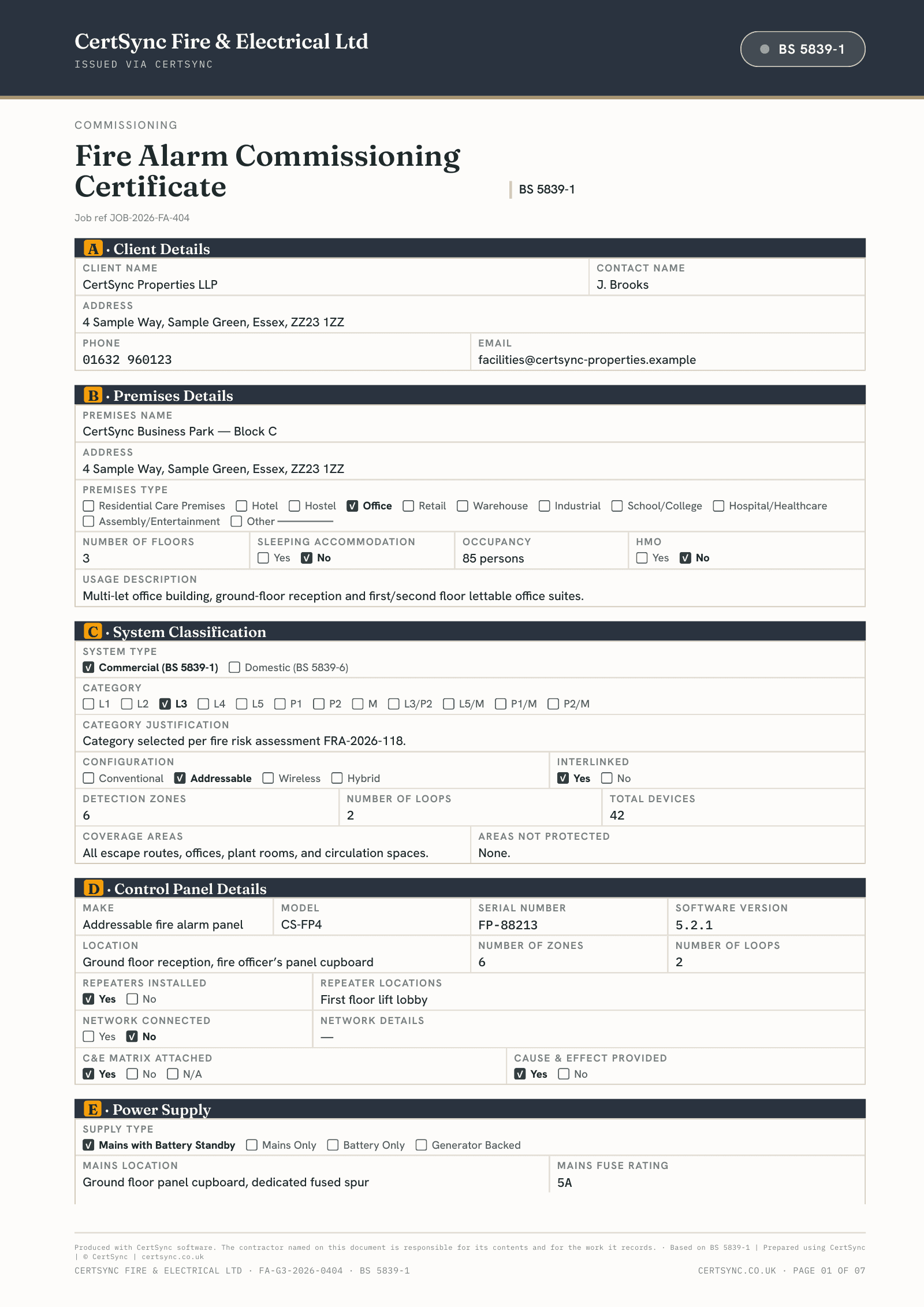
What this certificate includes
- One Fire Alarm certificate is issued as one of nine documents: the BS 5839-6 domestic certificate, the BS 5839-6 inspection and servicing certificate, or one of the seven BS 5839-1 Annex G documents for design, installation, commissioning, handover, verification, inspection and servicing, and modification.
- A domestic Grade A system is certified on its own design, installation, commissioning, handover and modification documents rather than the combined domestic certificate. Servicing of any domestic grade, Grade A included, uses the one BS 5839-6 inspection and servicing certificate.
- The form shows only the steps the chosen document prints. A section the document does not print stops being required, and anything already entered in it is kept rather than deleted.
- Non-domestic systems take a BS 5839-1 category (L1 to L5, P1, P2, M, or a combined category such as L3/P2); domestic systems take a BS 5839-6 grade and an LD or PD category. A domestic grade on a non-domestic certificate, or a non-domestic category on a domestic one, stops it being issued.
- Detector, call point and sounder schedules list every device by zone, loop, address, location, type, make and model. Detectors also record their response mode, sensitivity setting and whether a sounder base is fitted; sounders record the measured sound level and whether a visual alarm device is fitted.
- The Design and Installation documents print the device schedules without a test result column, because no device is tested at those stages. The documents that record testing carry a result for each device.
- If a total device count is recorded and it differs from the number of devices in the schedules, the certificate cannot be issued until one or the other is corrected.
- The Handover certificate can carry a cause-and-effect schedule, one row per trigger with its output action, output device and address, under the drawing reference. The Commissioning certificate records the cause-and-effect drawing reference and whether the matrix is attached.
- The Handover certificate records what was handed over: as-built drawings, cable test records, operating manual, maintenance schedule, log book, zone chart and spare parts, plus user training, the warranty period and whether a maintenance contract was offered.
- The Handover certificate has two signature panels, one for the engineer and one for the client or responsible person. It cannot be issued until the handover verdict is recorded as a pass or a fail and the engineer has signed and dated it.
- Every document needs the client name and its own signatory’s name, signature and date before it can be issued. The Commissioning and Modification certificates also need a recorded test result, and the Verification certificate needs its assessment of the design, installation or commissioning.
- A mains-only supply with no standby, or a supply type that contradicts the domestic grade, such as battery-only on a mains-powered grade, stops a certificate for new work being issued. Mains-only is accepted only when recording an existing system installed to the pre-2019 grading.
- The domestic certificate carries a four-part declaration covering the responsible person, the designer, the installer and the commissioning engineer, and every part must confirm compliance before it can be issued.
- The Inspection and Servicing certificate records the visit as a quarterly vented-battery check, a six-monthly or an annual visit and shows the checklist for that visit. It also records the false alarms in the last 12 months and any faults found.
- Once the certificate is issued, CertSync records when its re-inspection falls due, lists it in the Renewals due panel on your dashboard and emails you 90, 30 and 7 days before that date.
Domestic, commercial and industrial use
Domestic use
Domestic fire alarm certificates (BS 5839-6) cover houses, flats and other domestic premises. The standard provides a classification system of grades and categories: grades describe the type of system (from a Grade A fully monitored networked system to Grade F battery-only devices), and categories describe the extent of protection. CertSync produces a single combined certificate for Grades C, D1, D2, F1 and F2, covering the grade, category (LD1–LD3, PD1–PD2), device schedule and commissioning results. A Grade A system is certified on separate design, installation, commissioning, handover and modification certificates, each printed against BS 5839-1:2025 as amended by BS 5839-6. Servicing of any domestic grade, Grade A included, uses the BS 5839-6 inspection and servicing certificate.
Commercial use
Non-domestic fire alarm systems — offices, retail premises, restaurants, hotels, places of public assembly, schools and healthcare facilities — are governed by BS 5839-1:2025. Annex G of that standard defines a set of seven distinct certificate types, one for each phase of the system lifecycle. CertSync supports all seven: Design, Installation, Commissioning, Handover, Verification, Inspection & Servicing, and Extension or Modification. For a new system, CertSync issues G1, G2 and G3 as separate documents.
Industrial use
Industrial premises — factories, warehouses, logistics centres — require BS 5839-1:2025 non-domestic certificates. Large-scale industrial fire alarm systems often involve multiple zones, addressable device networks and cause-and-effect programming. CertSync records zone and device schedules, sound level measurements and the cause-and-effect configuration for these installations.
Certificate sub-types
Domestic
- Domestic Combined Certificate (BS 5839-6, Grades C, D1, D2, F1 and F2)
- Grade A Design Certificate
- Grade A Installation Certificate
- Grade A Commissioning Certificate
- Grade A Handover Certificate
- Grade A Extension or Modification Certificate
- Inspection & Servicing Certificate (BS 5839-6, all grades)
Non-domestic (BS 5839-1:2025 Annex G)
- G1 — Design Certificate (BS 5839-1:2025 Annex G)
- G2 — Installation Certificate
- G3 — Commissioning Certificate
- G4 — Handover Certificate
- G5 — Verification Certificate
- G6 — Inspection & Servicing Certificate
- G7 — Extension or Modification Certificate
How to complete a fire alarm certificate in CertSync
The Fire Alarm wizard starts by choosing the document you are issuing. The steps shown, and what each requires, follow from that choice: a step the chosen document does not print is skipped by Continue and Back.
- Client DetailsUnder Certificate Type choose the Installation Sector (Domestic, or Commercial / Industrial). Domestic: record the Grade, answer whether the dwelling is rented and whether any storey is larger than 200 m², then choose the Certificate Form. Commercial / Industrial: choose the Annex G form. Then enter the client information.
- PremisesEnter the Premises Address and the Building Details.
- System ClassificationRecord the System Type. Commercial systems take a Category (L1 to L5, P1 or P2, or M) with a Category Justification. Domestic systems take a Category (LD1 to LD3, or PD1 or PD2); LD2 and PD2 also need the Areas Protected recorded. Then the System Configuration.
- Control PanelRecord the panel make, model, serial number and location, and the Cause & Effect description (with an optional matrix document).
- Detector ScheduleAdd each detector with its location and type.
- Manual Call PointsAdd each manual call point.
- Sounder ScheduleAdd each sounder.
- System InterfacesRecord the system interfaces, including any connection to an alarm receiving centre.
- Power SupplyRecord the Power Supply Type, the Standby Duration Required and Actual Standby Duration, and the Battery Details.
- Commissioning TestsRecord the visual inspection date, detectors tested, sound level readings and the Test Equipment Used.
- DeclarationsSign the declarations that the chosen document carries (for the domestic combined certificate, Parts 1 to 4: Responsible Person, Designer, Installer and Commissioning Engineer).
- Photos & Supporting DocumentsAttach photos and supporting documents.
- Handover & DocumentationRecord the documentation handover, warranty, log book and, where there are any, the Variations from BS 5839.
Pick the document before anything else. The Certificate Form decides which steps and fields apply, so changing it halfway can hide steps you have already completed (the values are kept, they just stop being required).
Frequently asked questions
- Which standard applies to my project — BS 5839-6 or BS 5839-1:2025?
- BS 5839-6 applies to domestic premises — houses, flats and other dwellings used as private homes. BS 5839-1:2025 applies to non-domestic premises including offices, retail, hospitality, healthcare, education and industrial buildings. Some mixed-use and residential-above-commercial buildings may require both standards for different parts of the premises. CertSync supports both and allows you to select the correct document type at the start of the wizard.
- How many documents do I need for a new non-domestic fire alarm system?
- For a new non-domestic fire alarm system, CertSync issues G1 Design, G2 Installation and G3 Commissioning as separate documents, one for each phase of the work. Additional certificates (Handover, Verification, Inspection & Servicing, Extension or Modification) cover later stages. CertSync produces each as a separate document against the same customer and site.
- Are Grade B and Grade E still used for domestic systems?
- No. Grade B (panel-based system with radio-linked devices) and Grade E (system with mixed mains and battery devices on separate circuits) were removed from BS 5839-6 in the 2019 edition. Grades B and E are not offered for new work in CertSync; an existing pre-2019 system can be recorded under a legacy grade. The current domestic grades are A, C, D1, D2, F1 and F2.
- What do the L and P categories mean for non-domestic systems?
- In BS 5839-1, the L categories (L1 to L5) describe systems intended to protect life, ranging from full coverage to defined parts of a building. The P categories (P1 to P2) describe systems intended to protect property. Category M denotes a manual system. CertSync lets you record the system category for the installation as part of the certificate.
- What is cause and effect in a fire alarm system?
- Cause and effect describes how the system responds when a particular detector or call point activates — which sounders operate, which doors release, which plant shuts down. It is a core part of commissioning a non-domestic system. CertSync records the cause-and-effect drawing reference on the Commissioning certificate, and the full matrix, trigger by trigger, on the Handover certificate.
- Can CertSync keep all the Annex G certificates for one system together?
- Yes. CertSync produces each of the seven BS 5839-1:2025 Annex G certificates as a separate, individually signed document, and all of them sit against the same customer and site. That gives an ordered record of the system from design through to servicing.
- How is a domestic Grade A fire alarm certified?
- A Grade A system is designed, installed and certified as a BS 5839-1 system, with BS 5839-6 taking over on a handful of topics such as audible alarms and standby supplies. CertSync issues it on separate design, installation, commissioning, handover and modification certificates, each printed against BS 5839-1:2025 as amended by BS 5839-6:2019+A1:2020. Servicing uses the same inspection and servicing certificate as every other domestic grade.
- How do I complete a Fire Alarm certificate in CertSync?
- The Fire Alarm wizard starts by choosing the document you are issuing. The steps shown, and what each requires, follow from that choice: a step the chosen document does not print is skipped by Continue and Back. The steps are: Client Details; Premises; System Classification; Control Panel; Detector Schedule; Manual Call Points; Sounder Schedule; System Interfaces; Power Supply; Commissioning Tests; Declarations; Photos & Supporting Documents; Handover & Documentation.
Related certificates and guides
Get started with CertSync
Start free — first month on us. All 13 certificate types, one subscription.
First month free, card required, then From £15/month. No fixed-term contract. Cancel any time.