Certificate type
Visual Inspection Report (VIR) software
BS 7671:2018+A4:2026 principles — visual-only report, not a BS 7671 model form
The VIR records the findings of a visual check of an electrical installation without the full testing regime of an EICR. It is often used as a preliminary step — to identify obvious defects, assess the condition of accessible equipment and inform whether a full periodic inspection is warranted. Letting agents, local councils and housing associations frequently request a VIR as part of a pre-tenancy or pre-purchase process.
What is a Visual Inspection Report (VIR)?
A Visual Inspection Report (VIR) records the findings of a visual-only check of an electrical installation — no testing is carried out. It captures the condition of accessible equipment, obvious wiring defects and any items of immediate concern, giving a documented snapshot of visible condition.
Key features
- Scope and limits — the areas inspected and anything that could not be seen
- Named visual sections — supply and earthing, earthing and bonding (visual only), consumer unit, further distribution boards, a list of final circuits (condition only, no readings), meter and supply equipment, accessories, a location containing a bath or shower, external installations and visible cable condition
- Observations and recommendations with photo evidence, and a condition summary
- Tenant acknowledgement — records whether the tenant acknowledged the findings
- Next inspection recommendation, with the verdict and declaration on page 1
- Client details carry forward — cross-certificate memory fills address and client fields from previous visits
How is the certificate printed, sent and checked?
- The sign-off and declaration sit on page 1, with the detailed records after them.
- Every option on the form is printed, with your answer ticked, so the reader sees what was chosen and what was not.
- The footer reads "Prepared using CertSync", and the certificate states that the contractor named on it is responsible for its contents.
- Print a QR sticker for the installation. Scanning it opens a public verification page that asks for the property postcode and keeps the customer’s personal details hidden.
- Email the signed PDF to your customer from the app. Sending needs a connection.
The issued certificate
See a real Visual Inspection Report (VIR)
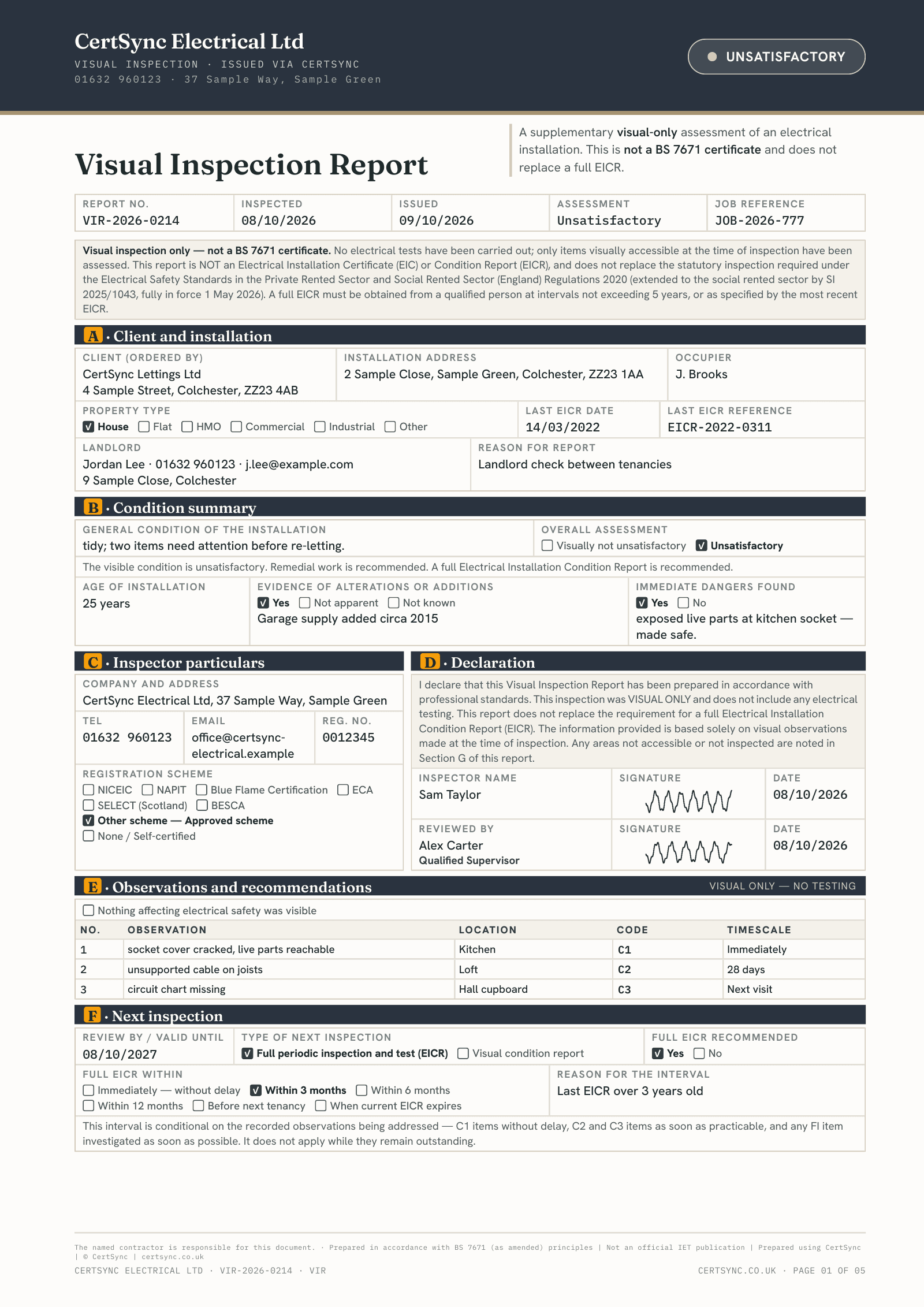
What this certificate includes
- Page 1 opens with a visual-only notice: no electrical tests were carried out, only visible and accessible items were assessed, and the report is not an EIC or an EICR.
- The scope lists the areas inspected, picked from common rooms or typed in, and the areas that could not be reached, with optional statements of the extent covered and the limitations agreed. At least one inspected area is needed before issue.
- Visual checks for the supply and earthing, the consumer unit and any further boards, accessories, visible cabling and earthing and bonding, with optional sections for the meter, external installations and a bath or shower location. Each area is rated Good, Fair, Poor or Not inspected.
- Final circuits can be listed one row each, with a description, the board it comes from, a condition and a note. There are no columns for test readings, because a visual inspection takes none.
- Each observation has a location, a description, a remedial timescale and a code: C1, C2, C3 or FI. No code is filled in for you, and every observation must be coded before the report can be issued.
- The overall assessment is Visually not unsatisfactory or Unsatisfactory, never Satisfactory. A C1 or C2 makes it Unsatisfactory; C3 and FI do not, and the printed verdict says when a finding could not be assessed without testing.
- When a C1 or an immediate danger is recorded, the report cannot be issued until the danger is described and a full EICR is recommended without delay.
- The form suggests whether a full EICR is needed and how soon, from the observation codes and condition ratings. You pick the timeframe: without delay, within 3, 6 or 12 months, before the next tenancy, or when the current EICR expires.
- The next inspection records a date, the reason for it and whether it should be a full periodic inspection and test or another visual report. A date in the past blocks issue, and so does a full inspection more than five years ahead where a landlord is named or the property is an HMO.
- The inspector’s name and signature are needed before issue, and a missing company name or phone number is flagged. An optional review block records a reviewer’s name, role, signature and date.
- An optional tenant acknowledgement records the tenant’s signature, or a refusal with the reason and a witness. It never stops the report being issued.
- Photos are tagged by subject, such as consumer unit, cable, meter or defect, and print on their own pages at the end of the report.
- For commercial and other non-domestic premises, the report adds a note that its format is a domestic convention and that a full EICR remains the right document for the installation.
- You can print a QR sticker for the board. The property postcode unlocks its public verification page, so a malformed postcode blocks issue.
Domestic, commercial and industrial use
Domestic use
Domestic VIRs are commonly requested by private landlords, letting agents and councils to get a rapid picture of an installation's visible condition before committing to a full EICR or ahead of a change of tenancy. CertSync structures the report to record accessible equipment condition, visible wiring defects and any items of immediate concern.
Commercial use
Commercial VIRs are used by facilities managers and property professionals to assess the visible condition of an installation prior to a full inspection programme, during a building acquisition, or as part of a planned maintenance review. For non-domestic premises the report states that its format is a domestic convention applied to those premises.
Industrial use
Industrial VIRs may form part of a planned maintenance schedule or be commissioned following a change of use or occupancy in order to assess the visible condition of the existing electrical infrastructure before a full inspection is arranged.
How to complete a Visual Inspection Report in CertSync
The VIR wizard records what you can see on a walk round. No electrical testing is carried out and no test values are entered.
- Property DetailsEnter the Property Address, Property Type, the approximate age of the installation, the date of the last EICR if known, who ordered the report and why, and the Landlord Details.
- Inspection ScopeRecord the Areas Inspected, the Extent of Installation Covered, any Areas Not Accessible and the agreed limitations of the inspection with the reasons.
- Visual InspectionWalk round and record each area in turn: Consumer Unit, Accessories, Cabling, Earthing & Bonding, External Installation, Meter & Equipment and Location Containing a Bath or Shower. These sections are optional; fill in what you saw.
- AssessmentGive the Overall Assessment, record any Immediate Dangers, set the EICR Recommendation, add Recorded Observations with a code each (C1, C2, C3 or FI), and the Key Findings & Recommendations.
- Photos & Supporting DocumentsAttach photos and supporting documents.
- Declaration & SignatureEnter the inspector and company details and the inspection dates, then sign. An optional Qualified Supervisor Review follows.
- Tenant AcknowledgementRecord the tenant’s acknowledgement of the findings, or the reason they refused.
Do not offer a VIR to a landlord as a way round the EICR requirement. Say plainly that it does not satisfy it.
Frequently asked questions
- What is the difference between a VIR and an EICR?
- A VIR is a visual check only — it records what the inspector can see without carrying out any testing of the installation. An EICR involves both visual inspection and testing, with test results recorded for circuits and equipment throughout the installation. A VIR is not a substitute for an EICR where testing is required by regulation or by the client's obligations.
- Does a VIR satisfy the landlord inspection requirement?
- No. The Electrical Safety Standards in the Private Rented Sector and Social Rented Sector (England) Regulations 2020 (extended to the social rented sector by SI 2025/1043, fully in force 1 May 2026) require a full EICR — not a VIR. A VIR is a preliminary visual report and does not fulfil the periodic inspection duty. Landlords who need to comply with the regulations require a full EICR with test results.
- When would a client request a VIR rather than a full EICR?
- Clients typically request a VIR when they want a rapid visual assessment ahead of purchasing a property, taking on a new tenancy, or commissioning a full inspection programme. It gives them a documented view of obvious condition without the full cost and access arrangements a complete periodic inspection requires.
- Can a VIR identify dangerous conditions?
- A visual inspection can identify obvious hazards — damaged accessories, exposed conductors, signs of overheating or unsafe modifications. Where a visible condition presents immediate danger, the appropriate response is to warn the client and, where necessary, issue an Electrical Danger Notice. Where a danger is recorded (as a C1 observation or as an immediate danger), the report cannot be issued until the danger is described and a full EICR is recommended without delay. A VIR does not replace the testing an EICR provides to confirm conditions that are not visible.
- Can I attach photos to a VIR?
- Yes. Because a VIR is a visual record, photographs are particularly valuable. Photos are added to the report, tagged by subject (consumer unit, accessory, cable, meter or intake, earthing and bonding, defect or other) and printed on their own pages at the end, so the client can see what was found.
- Who can carry out a VIR?
- A visual inspection should be carried out by a competent person familiar with electrical installations and the hazards they can present. As with all CertSync certificates, the inspector enters their own qualifications and scheme details — the platform does not verify competence, which remains the responsibility of the person signing the report.
- How do I complete a Visual Inspection Report (VIR) in CertSync?
- The VIR wizard records what you can see on a walk round. No electrical testing is carried out and no test values are entered. The steps are: Property Details; Inspection Scope; Visual Inspection; Assessment; Photos & Supporting Documents; Declaration & Signature; Tenant Acknowledgement.
- What overall result can a Visual Inspection Report give?
- Visually not unsatisfactory or Unsatisfactory. There is no Satisfactory option, because a visual-only inspection with no testing cannot positively confirm an installation is safe. Visually not unsatisfactory means only that no C1 or C2 danger was seen.
Related certificates and guides
Get started with CertSync
Start free — first month on us. All 13 certificate types, one subscription.
First month free, card required, then From £15/month. No fixed-term contract. Cancel any time.