Certificate type
Electrical Danger Notice software
Electricity at Work Regulations 1989 · Health and Safety at Work etc. Act 1974
When an electrician discovers an installation or part of an installation that poses an immediate risk to persons or property, a Danger Notice is the document used to formally notify the client and record the action taken. It records the nature of the danger, the risk classification, whether isolation was possible, and what the client has been advised. CertSync produces a signed notice that records what was found, what the person responsible was told, and when.
What is an Electrical Danger Notice?
An Electrical Danger Notice is a formal warning issued when an electrician finds an installation, or part of one, that presents an immediate risk to people or property. It records the nature of the danger, whether the supply was isolated, and that the client has been told. It is a warning record, not a certificate of compliance.
Key features
- The danger — all nine hazard types printed with the one found ticked, its location, risk level and photos
- Premises and people first — occupier, the person responsible and who ordered the work
- Isolation and making safe — whether the supply was isolated and how, locks and tags applied, and whether making safe was agreed
- Warnings given — warning notice placed and where, and any verbal warning
- Distributor (DNO) notification — whether it was needed, the reference and the date
- Customer signature, a witnessed refusal, or service with the occupier absent, plus the recommended action and its urgency
How is the certificate printed, sent and checked?
- Every option on the form is printed, with your answer ticked, so the reader sees what was chosen and what was not.
- The footer reads "Prepared using CertSync", and the certificate states that the contractor named on it is responsible for its contents.
- Print a QR sticker for the installation. Scanning it opens a public verification page that asks for the property postcode and keeps the customer’s personal details hidden.
- Email the signed PDF to your customer from the app. Sending needs a connection.
The issued certificate
See a real Electrical Danger Notice
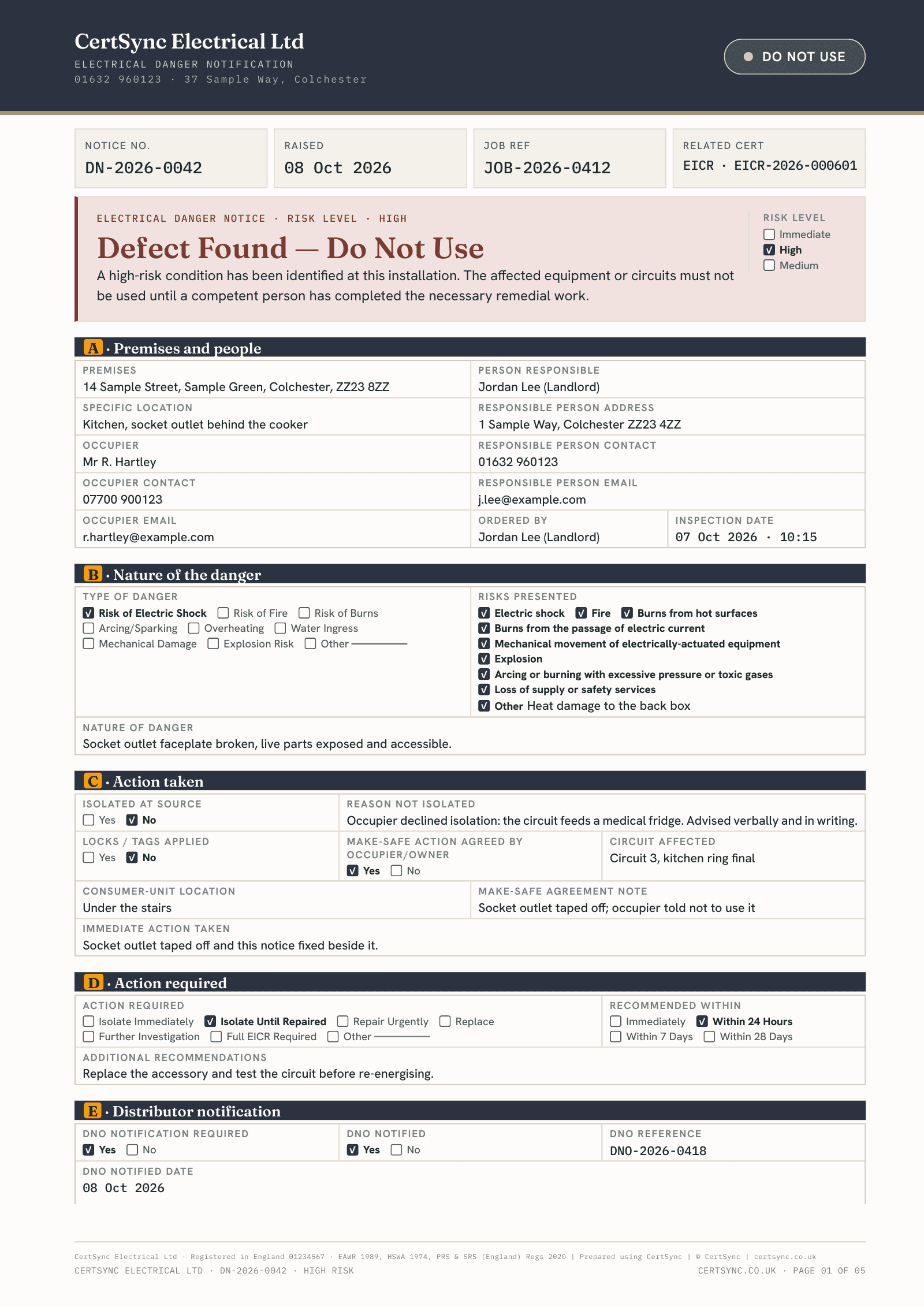
What this certificate includes
- Page 1 carries a danger banner that reads Do Not Use, with the risk level printed beside it. Its wording changes with whether the supply was isolated, so the notice never says something was isolated when it was not.
- The premises section records the occupier, the person responsible for the installation and their capacity (owner, landlord, managing agent or duty-holder) with their correspondence details, and who ordered the work. The person responsible must be named before the notice can be issued.
- The danger is recorded as a type (shock, fire, burns, arcing, overheating, water ingress, mechanical damage, explosion or other), its exact location and a written description. All three are needed before issue.
- You can also tick every risk the condition presents, from electric shock and fire to loss of supply to safety services, and the notice prints the full list with your choices ticked.
- The risk level is Immediate or High. A notice marked Immediate cannot be issued with an urgency other than Immediate, so it never gives someone weeks to deal with an immediate danger.
- Isolated at source needs a clear Yes or No. Yes needs the isolation method; No needs the reason it was not isolated, such as access denied. Locks and tags, whether making safe was agreed, and any other immediate action print in the action taken section.
- The action required section records the recommended action, from isolate immediately to a full EICR, and an urgency of immediate, 24 hours, 7 days or 28 days. Both are needed before issue.
- Distributor (DNO) notification is recorded as needed or not, with the reason, who made the call, the date and the reference. A reference is needed once the DNO is marked as told.
- When the recorded reason places the danger in the supply intake, such as the cut-out or meter, the notice prints a panel telling the recipient that the equipment belongs to the network operator and must be escalated to them.
- Whether a warning notice was placed needs a clear Yes or No; a Yes needs its location and type. Any verbal warning given is recorded too.
- The electrician signs a declaration on screen with their name, position, company, registration scheme and number. Only an installer, supervisor or admin can sign it; office staff cannot.
- The notice is resolved one of three ways before issue: the customer signs on screen with their name, the refusal to sign is recorded with a reason or a witness, or the notice is served with the occupier absent, with how and when.
- A separate page tells the recipient to pass the notice to whoever is responsible if that is not them, and explains that the notice accompanies any condition report rather than replacing it.
- A related certificate number and type (EIC, EICR or Minor Works) can be recorded and print on page 1, and photos of the danger print on their own pages after the notices.
Domestic, commercial and industrial use
Domestic use
Domestic Danger Notices are typically issued when an inspection or testing visit reveals a condition that makes the installation unsafe for continued use — such as an exposed live conductor, a failed earthing arrangement, or overloaded wiring. The document records that the client has been warned and sets out any isolation action taken.
Commercial use
Commercial Danger Notices arise in premises where an unsafe condition is found during inspection, maintenance or fault investigation — for example, inadequate protection against electric shock, damaged switchgear or a compromised earth. CertSync records the commercial premises details and the specific circuits or equipment affected.
Industrial use
Industrial environments can present particularly serious danger conditions given the higher supply voltages and currents involved. CertSync supports the full range of risk classifications and isolation record types encountered in factory and plant environments.
How to issue an Electrical Danger Notice
When you find a danger, the notice records the steps you take, in the order you take them.
- Make safe where you canIsolate the danger if the person responsible agrees, apply locks and tags, and record how. If isolation is refused or not possible, record why.
- Tell the person responsibleExplain the danger to the occupier or person responsible straight away, and record any verbal warning.
- Record the dangerRecord the danger type, where it is, the risk level and photos, and the action you recommend with its urgency.
- Place warnings and notifyPlace a warning notice where needed, and notify the distributor (DNO) when the danger is on their equipment.
- Sign and hand overSign the notice and ask the customer to sign. If they refuse, record the refusal and any witness, then give them the notice.
How to issue a Danger Notice in CertSync
The Danger Notice wizard is short. It records the dangerous condition, what you did about it, and who was told.
- Installation DetailsEnter the client and the installation address.
- Danger DescriptionRecord the Danger Type, the Risks Presented, and the Immediate Action Taken. Then complete the Technical Details: the circuit affected, the consumer unit location, how it was isolated, and whether the occupier or owner agreed to the make-safe action (Yes, No or Not recorded).
- Action RequiredChoose the Recommended Action and record whether the DNO needed to be told (DNO Notification Required), whether it was (DNO Notified) and why. Track the Follow-up and record whether a warning notice was placed and whether a verbal warning was given.
- Electrician DetailsEnter your details, scheme and registration number.
- Photos & Supporting DocumentsAttach photos of the condition.
- AcknowledgementRecord the Customer Acknowledgement and sign. If the customer would not sign, tick Customer Refused to Sign and give the Refusal Reason and, if witnessed, the Witness Name. If the occupier was absent, tick Notice Served — Occupier Absent/Unresponsive and record the Service Method.
Issuing the notice does not make the installation safe. It records the danger and the advice given; the remedial work is a separate job.
Frequently asked questions
- When must a Danger Notice be issued?
- A Danger Notice should be issued whenever a person carrying out electrical work discovers a condition that presents an immediate danger to persons or property and the client needs to be formally notified. It is not a certificate of compliance — it is a formal record that a dangerous condition was identified, the client was warned, and any action taken was recorded.
- Does a Danger Notice replace an EICR?
- No. A Danger Notice is issued in response to an immediate unsafe condition and records the warning given to the client. It does not constitute a full periodic inspection report. Where an EICR was the original purpose of the visit, the EICR should also be completed recording the Unsatisfactory outcome and the C1 observation(s) that gave rise to the danger.
- What happens if the client refuses to allow isolation?
- Explain the danger again, make safe whatever you can without isolating, and record what you offered and what the client said. The notice records the situation as found, the action recommended and the refusal, and the customer can sign it or the refusal can be witnessed. Where the danger is on the distributor’s equipment, tell the distributor (DNO) and record the reference.
- Is a Danger Notice a legal requirement?
- There is no single statute that prescribes a "Danger Notice" form, but issuing one is established good practice and supports the duties under the Electricity at Work Regulations 1989 and the Health and Safety at Work etc. Act 1974. Industry guidance expects a C1 danger to be reported to the person responsible straight away and in writing. The notice is that written record: what was found, what they were told and when. Your duties and theirs both carry on after it is issued.
- Can I email a Danger Notice to the client on site?
- Yes. Because timing matters, CertSync lets you complete, sign and email a Danger Notice directly from the app while you are still on site. The signed PDF is stored with the job and records the inspection date (and time, if entered) and the date the notice was raised. Sending needs a connection.
- Does issuing a Danger Notice make the installation safe?
- No. The notice records that a danger was identified and the client warned — it does not by itself remedy the fault. Safe isolation, making safe, and any remedial work are separate actions. Where remedial work is then carried out, the appropriate certificate (an EIC or MEIWC) is issued for that work.
- How do I issue a Danger Notice in CertSync?
- The Danger Notice wizard is short. It records the dangerous condition, what you did about it, and who was told. The steps are: Installation Details; Danger Description; Action Required; Electrician Details; Photos & Supporting Documents; Acknowledgement.
- How do I record that the customer refused to sign a Danger Notice?
- On the Acknowledgement step tick Customer Refused to Sign and enter the Refusal Reason. If someone saw the refusal, tick Refusal Witnessed and enter their name. If the occupier was simply absent or unresponsive, use Notice Served — Occupier Absent/Unresponsive instead and record the Service Method.
Related certificates and guides
Get started with CertSync
Start free — first month on us. All 13 certificate types, one subscription.
First month free, card required, then From £15/month. No fixed-term contract. Cancel any time.