Certificate type
Temporary Electrical System (BS 7909) Certificate software
BS 7909:2023+A1:2024
The BS 7909 certificate records the design, installation and testing of a temporary electrical distribution system for an event — a festival, a marquee wedding, an exhibition or an outdoor broadcast. It applies identically regardless of venue type; the real variation is the scale and complexity of the system, which BS 7909 splits into a full distribution system and a "Small & Simple" system of up to 6kVA. CertSync structures the certificate around whichever applies, and around whether the system is a new completion or a periodic re-inspection of a system reused for a repeat event.
What is a BS 7909 temporary electrical system certificate?
A BS 7909 Temporary Electrical System Certificate records that a temporary electrical system for an event has been inspected and tested with reference to BS 7909:2023+A1:2024, and whether its design was confirmed by the Senior Person Responsible or a competent designer. It documents the schedule of test results and, for a multi-subsystem installation, confirms every subsystem's connection and testing.
Key features
- Completion Certificate or Completion Certificate (Re-inspection) — a re-inspected system re-issues as a Completion Certificate per BS 7909, not a separate periodic form
- Small & Simple system classifier — a condensed assessment record for systems up to 6kVA that are also indoors and socket-fed, with the qualifying questions asked up front
- Full multi-subsystem confirmation for larger distribution networks — generators, boards, outlying supplies
- Schedule of test results built into the wizard, matching the BS 7909 test-record structure
- Guidance notes written to the 2023 revision — including its "override" wording for RCD suppression, in place of "disable" or "bypass"
- Cross-certificate memory — client and contact details carry across certificates for the same customer
How is the certificate printed, sent and checked?
- Every option on the form is printed, with your answer ticked, so the reader sees what was chosen and what was not.
- The footer reads "Prepared using CertSync", and the certificate states that the contractor named on it is responsible for its contents.
- Print a QR sticker for the installation. Scanning it opens a public verification page that asks for the property postcode and keeps the customer’s personal details hidden.
- Email the signed PDF to your customer from the app. Sending needs a connection.
The issued certificate
See a real BS 7909 temporary electrical system certificate
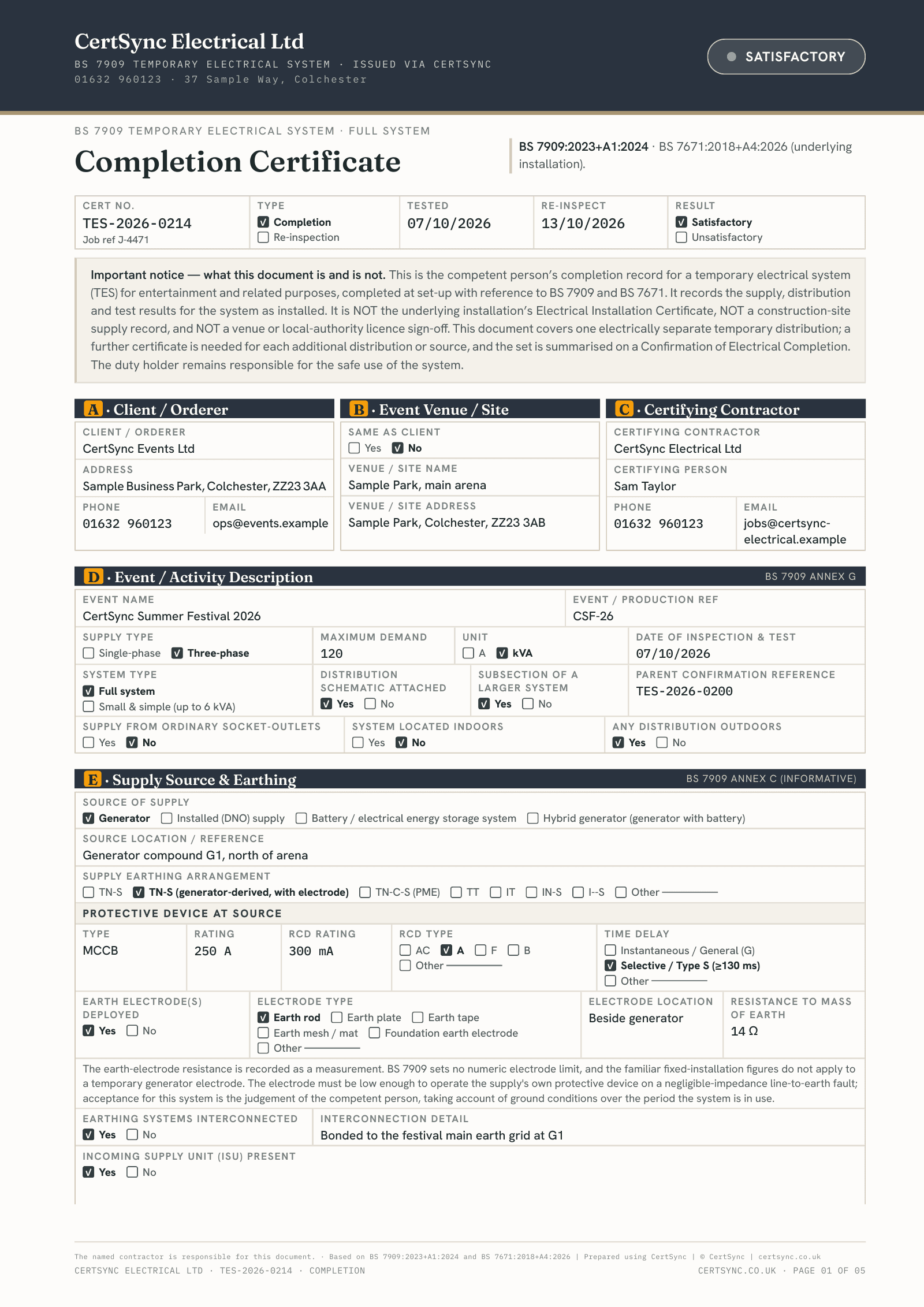
What this certificate includes
- Two choices shape the document: whether this is a first completion or a re-inspection, and whether the system is a full system or a small & simple one. Both must be chosen before the certificate can be issued.
- There is no separate periodic form. A re-inspection re-issues the Completion Certificate, titled as a re-inspection, with the previous certificate’s reference and a reason for the re-inspection, such as a re-rig at the same site or a change of supply. The reason is needed before issue.
- Choosing small & simple is checked, not taken on trust. The form asks whether the system is fed from ordinary wall socket-outlets, whether it is indoors and whether any distribution runs outdoors. A generator or battery supply, or any outdoor distribution, stops it being issued as small & simple, and so do unanswered questions.
- A recorded supply capacity or maximum demand above the BS 7909 small & simple limit is also flagged before a small & simple record is issued. An amp figure is converted using the recorded number of phases.
- A small & simple system gets an assessment record with a condensed checklist, not a Completion Certificate: equipment within its test date, the RCD test button and rating, supply and final-circuit polarity and earth continuity spot checks, and a visual inspection.
- The event section records the client or organiser, the venue name and address, the event name and reference, single- or three-phase supply, maximum demand in A or kVA, and the date of inspection and test. An event or venue name and the test date are needed before issue.
- The supply can be a generator, an installed supply, a battery storage system or a hybrid generator. The earthing choices include arrangements used on temporary systems, such as a generator-derived TN-S with an electrode and IN-S, alongside the fixed-installation ones.
- An earth electrode’s resistance is recorded as a measurement with no pass mark attached; the certificate explains that acceptance is the competent person’s judgement. Answering that an electrode is deployed means its resistance must be recorded before issue.
- The full-system schedule records each circuit: final or distribution, whether it feeds socket-outlets, the protective device, the RCD and whether its figures were measured or button-tested, polarity, phase sequence, Zs, prospective fault current, insulation resistance and comments. At least one circuit is needed before issue.
- On a generator-derived supply, a final circuit recorded with no RCD, or with an RCD rated higher than BS 7671 Regulation 551.4.4.2 allows, stops the certificate being issued.
- Readings are checked before issue: Zs against limits drawn from BS 7671 Tables 41.3 and 41.5 for the circuit’s protective device, insulation resistance against the Table 64 minimum and a measured RCD operating time against its limit. A failing reading, polarity recorded as wrong or an incorrect phase sequence is flagged before you issue.
- A full system must answer all five essential checks: visual inspection, polarity, earth fault loop impedance, the RCD test button and evidence that connected equipment has been tested. Any check answered unsatisfactory blocks issue.
- For an event with several sub-systems, a confirmation of electrical completion page lists each one with its responsible person, organisation and certificate reference, and the Senior Person Responsible signs there. A certifying person and the Senior Person Responsible must both be named before issue.
- The planned start and removal dates are recorded, and the document prints the duration worked out from them. If you enter a re-inspection due date, CertSync emails you before it falls due. Leave it blank and no reminder is sent; CertSync never calculates one.
Domestic, commercial and industrial use
Domestic use
A private event — a wedding marquee or a garden party — uses exactly the same BS 7909 certificate as a large public event. There is no separate domestic form; the venue type does not change the requirement, only the scale of the system does.
Commercial use
Festivals, exhibitions and corporate events are the most common setting for BS 7909 certification, typically involving a full distribution system with multiple subsystems — generators, distribution boards, outlying supplies to stalls or stages. CertSync's multi-subsystem confirmation records each one.
Industrial use
Outdoor broadcast, touring production and large-scale exhibition rigs sit at the upper end of BS 7909's scope, often with substantial generator capacity and complex distribution. CertSync's full-system certificate scales to these larger, more complex temporary installations.
Frequently asked questions
- What's the difference between a Completion and a Periodic BS 7909 certificate?
- BS 7909 does not have a separate periodic-inspection form. When a temporary system that has been in storage or previously used is re-erected, the re-inspection is documented by re-issuing a Completion Certificate rather than a distinct periodic document. CertSync's picker reflects this — Completion Certificate or Completion Certificate (Re-inspection) — and both produce the same certificate structure.
- What counts as a "Small & Simple" BS 7909 system?
- Capacity is only part of it. BS 7909 splits systems requiring up to 6kVA from those requiring in excess of 6kVA, but a system also has to be genuinely simple to fall on the small side: typically indoors, fed from ordinary wall socket-outlets, with little equipment. A physically small system that runs off a generator, or has leads run outdoors, counts as large and complex whatever its kVA. CertSync asks those questions before accepting the classification. Note too that BS 7909 requires no completion documentation for a genuinely small and simple system — CertSync produces an assessment record for one voluntarily, typically for a venue owner or event organiser, not a Completion Certificate.
- Does the BS 7909 certificate include the test results?
- Yes. The schedule of test results is built into the wizard and prints with the certificate. Where the system has several subsystems, a confirmation page lists each one, and the person responsible for the whole system signs on that page.
- Do I need a new BS 7909 certificate every time I re-erect the same rig?
- Yes. A re-erected rig is re-tested and gets a new Completion Certificate. Choose the re-inspection option to show it is a re-inspection of a system already commissioned, such as a re-rig at the same site, rather than a new one. CertSync's cross-certificate memory carries the client and contact details forward.
- Is a BS 7909 certificate different for a wedding marquee vs a festival?
- The certificate itself is identical — BS 7909 applies the same regardless of venue type. What differs is the scale and complexity. A wedding marquee fed from the venue's own socket-outlets may well be Small & Simple; the same marquee on a generator in a field is a full system, because a generator-fed or outdoor system is large and complex whatever its capacity. A festival is a full multi-subsystem distribution system in almost every case.
- How does a temporary system's supply relate to the venue's permanent EIC?
- The temporary system typically connects to a permanent supply point — a generator or a venue's fixed installation. Record the EIC or EICR for the permanent supply separately; the BS 7909 certificate covers only the temporary system.
Related certificates and guides
Get started with CertSync
Start free — first month on us. All 13 certificate types, one subscription.
First month free, card required, then From £15/month. No fixed-term contract. Cancel any time.